FINANCE
Veterans Guide to Small Business Loans and Funding
Starting a business after military service can be an exciting way to build financial independence...
Learn More

 September 3, 2026
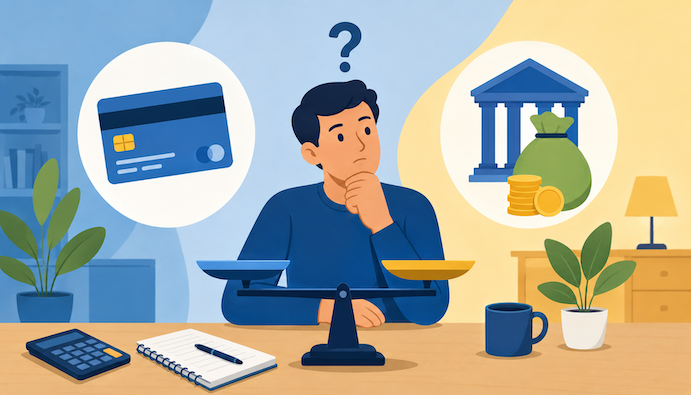
Choosing between a personal loan or credit card can be confusing, especially when you need to borrow money for a large purchase, unexpected expense, or debt consolidation. Both options give you access to credit, but they work very differently.
A credit card can be convenient when you need flexible spending and can repay the balance quickly. A personal loan may make more sense when you need a larger amount of money and want predictable monthly payments over a set period.
So, which one is better?
The answer depends on how much you need to borrow, how quickly you can repay it, the interest rate you qualify for, and the fees attached to the account. Instead of choosing based only on the amount you need, compare the total cost of borrowing and make sure the monthly payment fits comfortably within your budget.
The biggest difference between a credit card and a personal loan is how you borrow and repay the money.
A credit card is a revolving line of credit. You receive a credit limit and can generally borrow, repay, and borrow again as long as you remain within the account’s terms and available credit.
A personal loan, on the other hand, typically provides a lump sum upfront. You then repay that amount through scheduled payments over a specific loan term.
This difference makes each option better suited to different situations.
For example, a credit card may work well when you have several smaller purchases and expect to pay them off relatively quickly. A personal loan may be more appropriate when you know exactly how much you need and want a predictable repayment schedule.
A credit card may be the better option when you need flexibility or expect to repay the balance relatively quickly.
If you can pay off your purchase within a short period, a credit card can be convenient. Some cards offer promotional APR periods, including 0% APR offers on qualifying purchases.
However, promotional rates do not necessarily last forever. Once the promotional period ends, the regular APR may apply. Before using a promotional offer, understand the expiration date, applicable fees, and what happens to any remaining balance.
The CFPB notes that promotional APRs are generally temporary, so consumers should pay close attention to when the promotional period ends.
A credit card gives you access to a revolving credit line instead of providing one fixed lump sum.
That can be useful for expenses that happen over time. Rather than borrowing a large amount immediately, you can use the card as needed, provided you stay within your credit limit and can manage the repayments.
Depending on the card, you may receive rewards, cash back, points, purchase protections, or other benefits.
These features can add value when you already plan to make the purchase and can pay the balance responsibly. However, rewards should not be the deciding factor if carrying the balance will result in substantial interest charges.
For a relatively straightforward purchase that you can comfortably repay, using an existing credit card may be simpler than applying for a separate personal loan.
Just remember that convenience does not automatically make credit cards cheaper.
A personal loan may be a better fit when you need a specific amount of money and want a structured repayment plan.
Personal loans can provide a lump sum that may be more appropriate for larger expenses than putting the entire cost on a credit card.
The amount you can borrow depends on the lender, your creditworthiness, income, existing debt, and other factors. There is no universal dollar amount at which a personal loan automatically becomes the better choice.
Instead, compare the actual offers available to you.
You can learn more about personal financing options for larger planned expenses before deciding how you want to fund the purchase.
One of the biggest advantages of many personal loans is a defined repayment schedule.
You generally receive a set amount and make scheduled payments over the loan term. This can make budgeting easier because you know how much you are expected to pay each month.
By comparison, credit card payments can fluctuate depending on your balance, interest charges, and the payment amount you choose.
A personal loan can make sense when you need several months or years to repay a significant expense.
However, a longer loan term is not automatically better. Extending the repayment period may reduce your monthly payment while increasing the total amount of interest you pay.
Before accepting a longer term, calculate both the monthly payment and the total repayment amount.
A personal loan can sometimes be used to consolidate several debts into one monthly payment.
For example, someone with multiple high-interest balances may consider using a personal loan with a lower APR to simplify repayment.
But consolidation only makes financial sense if the new loan actually improves the overall cost or makes the debt substantially easier to manage. You should compare the new loan’s APR and fees with the interest rates and costs of the debts being consolidated.
The FTC notes that debt-consolidation loans can simplify multiple debts into one loan, but consumers should calculate the costs carefully before deciding.
There is no universal answer.
The cheapest option depends on the specific credit card and personal loan offers you qualify for.
Rather than assuming one product is always cheaper, compare these factors:
The APR is one of the most useful numbers for comparing borrowing costs because it incorporates the interest rate and certain fees.
The CFPB explains that APR is designed to help consumers compare the cost of different credit products.
When comparing a personal loan with a credit card, look at the applicable APR for the period in which you expect to carry the balance.
A credit card may advertise a 0% or low introductory APR, but that rate is usually temporary.
A card can be attractive during the promotional period but considerably more expensive afterward if you still have a balance.
Before accepting the offer, find out when the introductory rate ends and what regular APR will apply afterward.
Personal loans may include fees such as origination, documentation, or late-payment fees.
The CFPB recommends reviewing the loan disclosure and understanding all applicable fees before accepting a personal installment loan.
Don’t focus only on the advertised interest rate. A loan with a slightly lower rate but significant fees may not be cheaper overall.
The most important question is ultimately:
How much will you pay in total?
A low monthly payment can look attractive, but a longer repayment term can result in substantially more interest over the life of the loan.
Before borrowing, calculate the total amount you will repay, including interest and applicable fees.
A 0% introductory APR credit card can be useful for a planned purchase if you have a realistic strategy for paying off the balance before the promotional period ends.
For example, if you need to finance a purchase and the card offers a sufficiently long introductory period, dividing the balance by the number of promotional months can give you a target monthly payment.
The important part is not simply getting a 0% offer. You need to make sure you can actually eliminate the balance before the regular APR takes effect.
Also check whether the promotional APR applies to purchases, balance transfers, or both. Credit cards can have different APRs for different types of transactions.
Credit cards are convenient, but that convenience can make it easy to accumulate debt.
If you carry a balance after an introductory offer expires, the regular APR can significantly increase your borrowing costs.
That’s why a promotional offer should be treated as a repayment deadline rather than free money.
Making only the minimum payment can keep the balance around for a long time.
The FTC notes that paying less than the full balance can result in interest charges and make credit more expensive.
Using a large portion of your available credit can affect credit scoring calculations.
If a major purchase uses most of your available credit limit, consider how that balance could affect your overall credit profile while it remains outstanding.
Credit cards can have annual fees, balance-transfer fees, cash-advance fees, late fees, and other charges depending on the account.
Always read the card’s terms before assuming the promotional rate is the only cost involved.
Personal loans also have potential drawbacks.
Some lenders charge an origination fee or other charges associated with the loan.
A fee can reduce the amount you actually receive or increase the overall cost of borrowing, depending on how the lender structures it.
For this reason, don’t compare personal loans based solely on their advertised interest rate.
A personal loan gives you a defined payment schedule, which can be helpful, but you still need to make each payment on time.
Missing payments can result in fees and can negatively affect your credit history.
Choosing a longer repayment term can lower your monthly payment, but it may increase the total interest paid.
Always compare the total repayment cost before choosing the longest available term simply because the monthly payment looks more affordable.
Before choosing either option, ask yourself five questions.
Borrow only what you need and can reasonably repay.
For a credit card, consider how much of your available credit the purchase will use. For a personal loan, avoid borrowing more than necessary simply because you qualify for a larger amount.
Your repayment timeline is one of the biggest factors.
If you can repay a credit card balance quickly, especially under a genuine promotional APR, it may be worth considering.
If you need a longer, structured repayment period, a personal loan may provide a more predictable approach.
Don’t rely on advertised rates.
Your actual rate can depend on your credit profile and the lender’s underwriting criteria. Compare the offers you personally qualify for.
Look beyond the interest rate.
Check for annual fees, origination fees, balance-transfer fees, late fees, and other charges that could affect the total cost.
This may be the most important question.
A borrowing option is not a good choice if the payment stretches your budget too far. Before taking on new debt, consider your existing monthly obligations, income, emergency savings, and other financial priorities.
Imagine you need to finance a $6,000 purchase.
You could potentially put the purchase on a credit card, use a promotional APR if available, or apply for a personal loan.
The right choice would depend on the actual offers.
If the credit card provides a promotional APR long enough for you to pay the balance in full and has manageable fees, it could be an effective short-term financing option.
If the promotional period is too short or you expect to carry the balance for several years, a personal loan with a competitive APR and reasonable fees may be easier to manage.
The important point is that $6,000 by itself does not determine which product is better. The interest rate, fees, repayment period, and your ability to make the payments matter more.
Before signing up for new credit, compare the offers side by side.
Look at:
The CFPB recommends shopping around because different lenders may offer different rates and terms based on your circumstances.
It is also important to be cautious of anyone who promises guaranteed approval in exchange for an upfront payment. The FTC warns that advance-fee loan scams commonly promise credit before asking consumers to pay a fee.
A credit card may be the better choice when you need flexible access to credit, are making purchases over time, or can take advantage of a promotional APR and repay the balance within the promotional period.
A personal loan may be better when you need a specific amount, want predictable payments, or need a longer repayment period for a larger expense.
Neither option is automatically better for everyone.
The smartest choice is the one that gives you a manageable payment and the lowest reasonable total borrowing cost based on the offers available to you.
Most importantly, don’t choose a financial product simply because it has the lowest advertised rate or monthly payment. Look at the entire cost of borrowing before making a decision.
Not necessarily. A personal loan may be better for a larger, planned expense and a fixed repayment schedule, while a credit card may work better for flexible or short-term borrowing. Compare the actual APR, fees, and repayment costs before deciding.
It depends on the rates and fees you qualify for. A credit card with a 0% promotional APR can be inexpensive during the promotional period, while a personal loan may be more affordable than a high-interest credit card when repayment will take longer.
Yes, a personal loan can be used for debt consolidation in some circumstances. However, calculate the new loan’s interest, fees, repayment period, and total cost before transferring your debt.
No. A 0% APR offer can be useful, but the promotional period is limited. If you cannot repay the balance before the regular APR begins, the remaining balance may become expensive to carry.
It can. Depending on the lender, personal loans may have origination fees, documentation fees, late fees, and other charges. Review the loan disclosure carefully before accepting an offer.
Generally, no. Being approved for a larger amount does not mean you should borrow it. Borrow only what you need and what you can comfortably repay without putting unnecessary pressure on your budget.
Compare the APR, fees, repayment period, monthly payment, promotional terms, and total amount you will repay. Looking at the complete cost gives you a better basis for choosing between a credit card and personal loan.
So, personal loan or credit card—which is better for you?
It depends on your financial situation and how you plan to repay the money.
A credit card can provide flexibility and may be attractive for short-term borrowing, particularly when a legitimate promotional APR helps reduce interest costs. A personal loan can provide a predictable repayment schedule and may be more suitable for larger expenses or longer repayment periods.
Before making a decision, compare the actual offers available to you. Look beyond the monthly payment and advertised interest rate, and consider the APR, fees, repayment timeline, and total cost.
The goal isn’t simply to find a way to borrow money. It’s to choose a form of credit you can manage comfortably and repay responsibly.
Applying For A Loan?


How to Sell Business Internet Services to Small Businesses
Oct 23, 2026

Telecom Sales Call Quality Assurance: A Practical Guide
Oct 22, 2026
Telecom Dealer KPIs: Metrics That Drive Better Results
Oct 21, 2026

Telecom Sales Scripts That Help Turn Leads Into Sales
Oct 20, 2026

Telecom Lead Management: Follow Up Without Losing Sales
Oct 19, 2026


12
Oct, 2026
FINANCE
Starting a business after military service can be an exciting way to build financial independence...
8
Oct, 2026
BUSINESS LOAN
Choosing the best location for your business can have a major impact on visibility, customer...
29
Sep, 2026
FINANCE
If you are thinking about applying for a personal or business loan, it is important...