FINANCE
Veterans Guide to Small Business Loans and Funding
Starting a business after military service can be an exciting way to build financial independence...
Learn More

 September 29, 2026
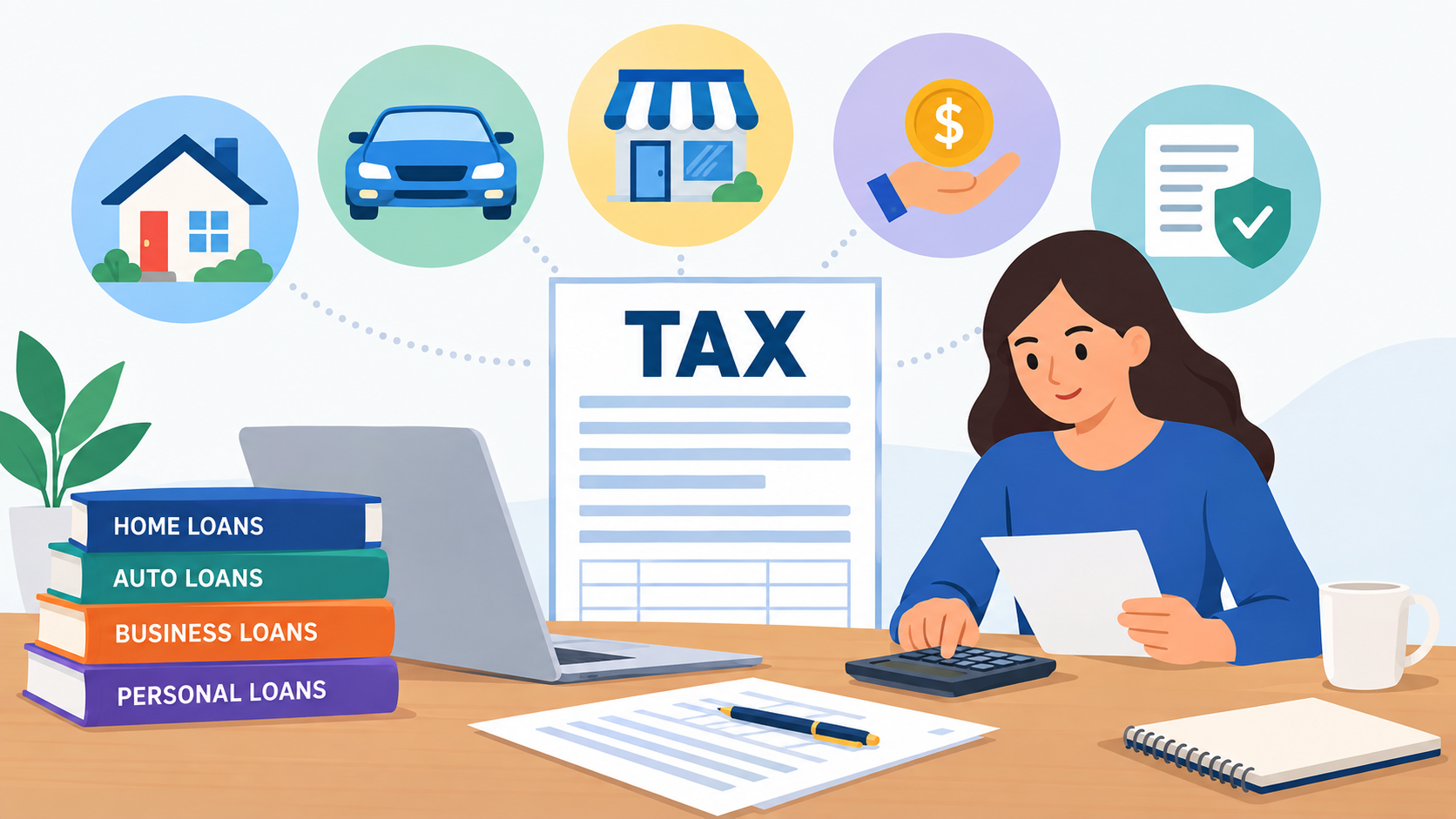
If you are thinking about applying for a personal or business loan, it is important to understand how borrowing money can affect your federal taxes. A loan itself generally is not taxable income because you have an obligation to repay the money. However, the interest you pay, how you use the borrowed funds, and whether a lender later forgives part of the debt can all have different tax consequences.
Mortgage loans, home equity loans, personal loans, business financing, and auto loans are not treated the same way for tax purposes. Some interest may qualify for a deduction, while other interest generally does not. In some situations, canceled debt can even become taxable income.
Understanding these differences before taking out a loan can help you keep better records, avoid overlooking eligible deductions, and prepare more accurately when tax filing season arrives.
Tax note: Federal tax rules can change, and eligibility depends on your individual circumstances. This article provides general information and is not a substitute for advice from a qualified tax professional.
See the products and features you can sell as a JNA authorized dealer.
Become a JNA Dealer
Taking out a loan generally does not create taxable income because the money must be repaid.
Mortgage interest may be deductible when the loan and property meet IRS requirements.
Home equity loan interest is generally deductible only when the borrowed funds are used to buy, build, or substantially improve the home securing the loan.
Interest on a personal loan used for personal expenses generally is not deductible.
Interest connected to qualifying business expenses may be deductible, subject to applicable rules and limitations.
Certain car-loan interest may now qualify for a federal deduction for tax years 2025 through 2028 if specific requirements are met.
Forgiven or canceled debt may become taxable income unless an exception or exclusion applies.
Keeping loan agreements, interest statements, receipts, and records showing how borrowed money was used can make tax preparation easier.
The most important distinction is between the loan principal and the interest paid on the loan.
When you borrow $20,000, for example, the $20,000 you receive generally is not considered taxable income because you are required to repay it. The tax treatment can change later depending on what you do with the money or whether some of the debt is forgiven.
Interest is different. Depending on the type of loan and how the proceeds are used, the interest may qualify for a tax deduction.
The IRS generally determines the treatment of interest by looking at factors such as the type of debt, the purpose of the borrowing, the property securing the loan, and how the proceeds were actually used. For business expenses, the IRS specifically notes that interest allocation can depend on tracing the loan proceeds to their use.
That means simply having a loan does not automatically create a tax deduction.
A mortgage is one of the most common loans associated with a potential tax deduction. If you itemize deductions and meet the applicable IRS requirements, you may be able to deduct qualified mortgage interest paid on your main home or a second home.
For qualifying mortgage debt incurred after December 15, 2017, the general limit is based on up to $750,000 of qualifying acquisition debt, or $375,000 for married taxpayers filing separately. Certain older mortgages can be subject to the previous $1 million limitation.
The date the mortgage was incurred matters, so homeowners should not assume that every mortgage is subject to the same limit.
Qualified mortgage interest generally relates to debt secured by your main home or second home. The property must meet IRS requirements, and the debt must qualify under the applicable home acquisition or other qualifying rules.
For homeowners, this can make the interest portion of mortgage payments an important consideration during tax preparation.
However, the deduction is not simply based on how much you paid toward your mortgage. Your eligibility can depend on the loan balance, when the debt was incurred, how the money was used, whether you itemize, and other circumstances.
Home equity loans and home equity lines of credit can create confusion because they are secured by your home.
The fact that your home secures the loan does not automatically make all of the interest deductible. Under current IRS guidance, interest on home equity debt generally cannot be deducted when the loan proceeds are used for purposes unrelated to buying, building, or substantially improving the home securing the debt.
For example, borrowing against your home to finance a qualifying home improvement project can receive different tax treatment from borrowing against your home to pay for a vacation or other personal expense.
This is one reason it is important to maintain documentation showing exactly how home equity funds were spent.
Personal loans can be used for many different purposes, including major purchases, debt consolidation, emergencies, travel, or household expenses.
In general, interest on a personal loan used for personal expenses is not deductible. The IRS specifically states that personal-loan interest cannot be deducted as a business expense when the loan is personal.
For example, if you borrow money to pay for a vacation, furniture, or another personal purchase, the interest generally does not qualify for a federal deduction simply because you paid interest during the year.
The purpose of the loan therefore matters more than simply the fact that it is called a personal loan.
The situation can be different when borrowed money is used for a legitimate business purpose.
If part of a loan is used for business and another part is used personally, the interest generally needs to be allocated between those uses. The business portion may qualify for a deduction if the applicable requirements are satisfied, while the personal portion generally does not.
For example, suppose a business owner uses borrowed funds to purchase office equipment and also uses part of the money for a personal expense. The interest should not automatically be treated as entirely business-related.
Keeping separate records of how the money was spent can help establish the business-use portion.
Business financing can have different tax consequences because interest connected with a trade or business may qualify as a business expense.
For example, financing used for qualifying business costs such as equipment, inventory, operating expenses, or other legitimate business purposes may produce deductible interest, depending on the taxpayer’s circumstances and the applicable limitations.
The IRS notes that certain taxpayers may be subject to limitations on business interest deductions. For tax years beginning in 2025, businesses may need to consider the rules under Section 163(j) and, when applicable, Form 8990.
The important point is that business borrowing should be documented carefully. Keep the loan agreement, payment records, interest statements, and documentation showing how the proceeds were used.
If you are considering different financing structures, understanding the distinction between secured and unsecured loans can also help you evaluate the financial and practical differences before borrowing.
Auto-loan tax rules have changed significantly.
For tax years 2025 through 2028, taxpayers may be able to deduct up to $10,000 per year of qualified passenger vehicle loan interest, subject to income limitations and other eligibility requirements. The deduction can be available to taxpayers who itemize and those who do not.
However, not every car loan qualifies.
Among the requirements, the loan must generally:
Be incurred after December 31, 2024.
Be used to purchase an applicable passenger vehicle.
Be secured by a first lien on the vehicle.
Be for personal use.
Involve a qualifying vehicle whose original use begins with the taxpayer.
Meet the U.S. final-assembly requirement.
Satisfy the other requirements established under the federal tax rules.
The IRS also states that the deduction is limited to $10,000 per return and applies for taxable years beginning after December 31, 2024, and before January 1, 2029.
Because these requirements are specific, taxpayers should verify that both the vehicle and financing arrangement qualify rather than assuming all auto-loan interest is deductible.
Business vehicle use can create another potential deduction.
If you are self-employed and use a vehicle for business, the portion of car-loan interest attributable to business use may be deductible under the applicable business rules. The IRS gives the example of a vehicle used 60% for business, where 60% of qualifying interest could be treated as business interest.
If the vehicle has both personal and business use, accurate mileage and expense records become particularly important.
You also cannot deduct the same interest twice. The IRS specifically addresses coordination between the qualified passenger vehicle loan interest deduction and a Schedule C business-interest deduction. (IRS)
Borrowing money is generally not taxable because you have an obligation to repay it. But what happens if the lender cancels, forgives, or discharges some or all of your debt?
That can create a completely different tax situation.
The IRS generally treats canceled debt as taxable income unless a specific exception or exclusion applies. A lender may issue Form 1099-C, Cancellation of Debt, reporting the canceled amount to both you and the IRS.
For example, if you borrowed $15,000 and a lender later forgives $5,000 of the outstanding balance, the $5,000 cancellation may be considered income for federal tax purposes unless an applicable exception or exclusion applies.
No. Several exceptions and exclusions can apply.
The IRS identifies situations that can affect whether canceled debt is taxable, including certain bankruptcies and cases where the taxpayer was insolvent when the debt was canceled. Other specific exceptions can apply depending on the type and circumstances of the debt.
This means receiving a Form 1099-C does not necessarily mean that the entire amount must automatically be treated as taxable income.
If the information on the form is incorrect, the IRS advises contacting the lender for a correction. You may also have reporting obligations even in situations where a particular canceled debt is excluded from income.
One of the simplest ways to make loan-related tax reporting easier is to maintain clear records from the beginning.
Keep copies of:
Loan agreements and closing documents
Annual interest statements
Mortgage statements
Receipts for qualifying home improvements
Business expense receipts
Vehicle mileage records
Records showing business versus personal use
Bank statements showing how loan proceeds were spent
Forms such as Form 1099-C when applicable
This documentation can be particularly important when a single loan is used for multiple purposes.
For business borrowing, the IRS emphasizes allocating interest based on the use of the loan proceeds.
A clear paper trail makes it easier to determine which portion of interest may qualify for a deduction and which portion does not.
| Loan Type | General Federal Tax Treatment |
|---|---|
| Mortgage | Qualified mortgage interest may be deductible when IRS requirements are met |
| Home equity loan | Interest may qualify when proceeds are used to buy, build, or substantially improve the home securing the loan |
| Personal loan | Interest for personal expenses generally is not deductible |
| Business loan | Interest connected with qualifying business use may be deductible, subject to applicable rules and limitations |
| Auto loan | Certain qualifying passenger vehicle loan interest may be deductible for 2025–2028 |
| Forgiven loan | Canceled debt may be taxable unless an exception or exclusion applies |
These are general federal rules rather than a determination of your individual tax situation.
If you have multiple loans, start organizing your records before tax season rather than waiting until the last minute.
First, identify each loan and its purpose. A mortgage used to purchase a home has different rules from a personal loan used for household expenses. Likewise, business financing may require you to separate business and personal use.
Next, gather your annual interest statements and other tax documents. If you received a Form 1099-C, review it carefully and compare it with your own records.
Finally, consider whether your situation involves multiple tax rules at the same time. A self-employed taxpayer with a mortgage, business loan, and vehicle used for work may have several different categories of interest to track.
When the rules become complicated, a tax professional can help determine which deductions and exclusions apply to your specific circumstances.
Paying interest does not automatically make it deductible. The type of loan and use of the borrowed funds are important.
Money received from a normal loan generally is not taxable income because it must be repaid. The tax situation can change if some of the debt is later canceled or forgiven.
Two loans with the same interest rate can have different tax treatment if the borrowed money is used for different purposes.
Using one loan for both business and personal expenses can make interest allocation more complicated. Keep detailed records so the appropriate portion can be identified.
The newer federal car-loan interest deduction has specific requirements involving the loan date, vehicle, use, lien, and other factors. Not every vehicle loan qualifies.
Generally, no. Loan proceeds normally are not taxable income because you have an obligation to repay the money. However, if a lender later cancels or forgives part of the debt, the canceled amount may become taxable income unless an exception or exclusion applies.
Usually not when the loan is used for personal expenses. If borrowed funds are used for a qualifying business purpose, the business portion of the interest may potentially be deductible, subject to applicable rules.
Qualified mortgage interest may be deductible for taxpayers who meet the applicable IRS requirements. The amount that can be deducted depends on factors including when the mortgage was incurred and the amount of qualifying debt.
It can be, but the use of the loan proceeds matters. Under current IRS guidance, interest generally is not deductible when home equity proceeds are used for unrelated personal expenses. The interest may qualify when the proceeds are used to buy, build, or substantially improve the home securing the loan.
For tax years 2025 through 2028, certain taxpayers may deduct up to $10,000 of qualified passenger vehicle loan interest, subject to eligibility and income limitations. The vehicle and loan must meet specific requirements.
Canceled or forgiven debt may be treated as taxable income unless a qualifying exception or exclusion applies. If applicable, the lender may issue Form 1099-C.
Keep loan agreements, interest statements, receipts, bank records, and documentation showing how borrowed funds were used. Business borrowers should also maintain records that distinguish business expenses from personal expenses.
Loans can affect your taxes in several different ways, but the tax treatment depends heavily on the type of loan and what you do with the borrowed money.
Mortgage interest can qualify for a deduction when the requirements are met. Personal-loan interest generally does not qualify for a personal deduction, while business-related interest may receive different treatment. Certain qualifying car loans can also receive a federal interest deduction under the rules currently covering tax years 2025 through 2028.
The other major issue is canceled debt. If a lender forgives part or all of a loan, the canceled amount may become taxable income unless an exception or exclusion applies.
Because tax rules can depend on the specific loan, filing status, income, property, and use of the funds, keep detailed records and verify your situation with the IRS or a qualified tax professional before claiming a deduction.

How to Sell Business Internet Services to Small Businesses
Oct 23, 2026

Telecom Sales Call Quality Assurance: A Practical Guide
Oct 22, 2026

Telecom Dealer KPIs: Metrics That Drive Better Results
Oct 21, 2026

Telecom Sales Scripts That Help Turn Leads Into Sales
Oct 20, 2026

Telecom Lead Management: Follow Up Without Losing Sales
Oct 19, 2026


12
Oct, 2026
FINANCE
Starting a business after military service can be an exciting way to build financial independence...

8
Oct, 2026
BUSINESS LOAN
Choosing the best location for your business can have a major impact on visibility, customer...

22
Sep, 2026
FINANCE
Starting a business requires more than a good idea. You also need enough capital to...