BUSINESS LOAN
How to Choose the Best Location for Your Business
Choosing the best location for your business can have a major impact on visibility, customer...
Learn More

 July 15, 2026
Taking out a business loan can be one of the smartest investments you make for your company. Whether you’re launching a startup, expanding into new markets, purchasing equipment, or managing cash flow during slower seasons, access to financing can create opportunities that might otherwise be out of reach.
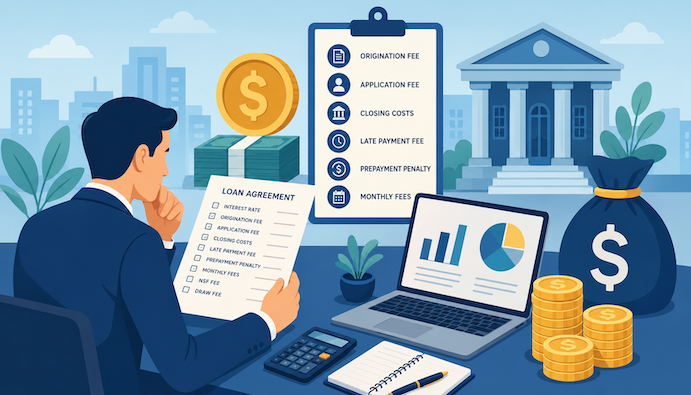
However, many business owners focus almost exclusively on the advertised interest rate. What often goes unnoticed is that the true cost of a business loan extends far beyond that single number. Lenders may include a variety of fees throughout the borrowing process, some of which are clearly disclosed while others are tucked away in the loan agreement.
These additional costs can significantly increase the amount you repay over the life of the loan. In some cases, they can even reduce the amount of funding you actually receive despite being approved for the full loan amount.
Understanding these fees before signing any agreement allows you to compare lenders more accurately, negotiate better terms, and avoid unnecessary financial surprises. If you’re preparing to apply for financing, it’s also worth reviewing the business loan requirements every lender looks for so you can strengthen your application before beginning the borrowing process.
In this guide, we’ll break down the most common business loan fees, explain why lenders charge them, and show you how they affect your overall borrowing costs.
When people think about borrowing money, they usually assume they’ll repay the amount borrowed plus interest. While interest is certainly one of the biggest expenses, it’s rarely the only one.
Most lenders charge additional fees to cover administrative work, underwriting, risk assessment, loan servicing, and operational expenses. These charges can appear before your loan is approved, when it’s funded, throughout the repayment period, or even when you pay it off.
Some fees are completely legitimate and standard across the lending industry. Others vary significantly depending on the lender, loan type, and your business profile.
The challenge is that many borrowers don’t calculate these expenses when comparing loan offers. As a result, a loan with a lower advertised interest rate may actually cost more than another loan once all fees are included.
Instead of evaluating financing based solely on the Annual Percentage Rate (APR) or interest rate, consider the total borrowing cost, including every fee that may apply throughout the life of the loan.
Not every lender charges the same fees, and not every loan includes every charge. However, these are among the most common costs business owners encounter when financing their operations.
An application fee covers the lender’s cost of reviewing your request for financing.
This process often includes verifying business information, reviewing financial statements, assessing repayment capacity, checking documentation, and performing credit evaluations. In many cases, lenders also evaluate your business history and projected revenue before deciding whether to approve the loan.
Application fees are usually charged before a lending decision is made. Depending on the lender, they may be:
Non-refundable
Deducted from the loan proceeds
Waived during promotional periods
Credited toward closing costs if the loan is approved
Although these fees are often relatively small, they can become expensive if you’re applying with multiple lenders simultaneously.
Businesses working to improve approval odds should first strengthen their financial profile, including their small business credit score before applying for financing, since stronger applicants may qualify for reduced fees or better loan offers.
Origination fees are one of the largest upfront costs associated with many business loans.
These fees compensate the lender for processing, underwriting, preparing documentation, and issuing the loan. Rather than charging separately for each administrative task, many lenders combine them into a single origination fee.
The fee is typically calculated as a percentage of the total loan amount, commonly ranging between 1% and 5%, although some alternative lenders charge even more.
For example:
Loan Amount: $100,000
Origination Fee: 3%
Fee Charged: $3,000
If the lender deducts this fee before disbursing funds, you’ll receive only $97,000 while still being responsible for repaying the full $100,000, plus interest.
This difference can impact your available working capital immediately after funding, making origination fees one of the most important costs to evaluate when comparing lenders.
Even financially healthy businesses occasionally experience temporary cash flow shortages.
When a scheduled payment isn’t received by the due date, lenders often assess late payment fees. These penalties may be structured as:
A flat dollar amount
A percentage of the overdue payment
Additional interest charges
Combined penalty structures
While a single late payment might seem insignificant, repeated penalties can quickly increase the total cost of borrowing.
Late payments may also negatively affect your business credit profile, making future financing more difficult or expensive.
Maintaining a dedicated repayment account, setting payment reminders, and using automatic withdrawals can help reduce the likelihood of missing payment deadlines.
Paying off debt early sounds like good financial management—and in many cases, it is.
Unfortunately, some lenders include prepayment penalties that discourage borrowers from paying off loans ahead of schedule.
Why?
Because lenders earn money from interest over the life of the loan. When you repay early, they collect less interest than originally expected.
Prepayment penalties may be calculated in several ways, including:
A percentage of the remaining balance
Several months of interest
A fixed administrative fee
Declining penalties based on how long you’ve held the loan
If your business expects significant growth, plans to refinance, or anticipates making larger principal payments in the future, reviewing the loan’s prepayment terms beforehand can save thousands of dollars.
Many lenders encourage automatic electronic payments because they reduce missed payments and simplify loan servicing.
However, automated payments can create another potential expense.
If your business bank account doesn’t contain enough funds when the lender initiates a withdrawal, you may incur a Non-Sufficient Funds (NSF) fee.
Depending on the situation, you could face:
An NSF fee from your bank
A returned payment fee from the lender
Additional late payment charges
Accrued interest during the delay
In some cases, a single missed withdrawal can trigger multiple fees from different financial institutions.
Maintaining a small cash buffer in the repayment account can help prevent these avoidable expenses and reduce disruptions to your repayment schedule.
Many entrepreneurs associate closing costs exclusively with commercial real estate or mortgage loans.
In reality, business loans often include closing costs as well.
These expenses may bundle together several administrative charges, including:
Origination fees
Document preparation
Legal review
Filing costs
Underwriting expenses
Administrative processing
Recording fees when collateral is involved
Some lenders provide a single closing cost estimate, while others list each fee individually.
Before accepting any financing offer, request a complete itemized breakdown to ensure you’re not paying duplicate charges or unnecessary administrative fees.
Comparing total closing costs—not just interest rates—provides a much clearer picture of the actual loan expense.
Businesses using revolving lines of credit may encounter draw fees each time they access available funds.
Unlike traditional term loans, a business line of credit allows you to borrow only what you need when you need it. While this flexibility is valuable, some lenders charge a fee for every withdrawal.
Draw fees may be:
A flat fee per transaction
A percentage of the amount withdrawn
Waived after a minimum withdrawal amount
Although each fee may seem relatively small, businesses that make frequent withdrawals can accumulate substantial additional borrowing costs over time.
If your company regularly relies on a line of credit for inventory purchases, payroll, or seasonal expenses, understanding draw fees is essential when comparing financing options.
Government-backed financing programs sometimes include guarantee fees that borrowers overlook during the application process.
For example, many Small Business Administration (SBA) loans require lenders to pay a guarantee fee in exchange for federal backing that reduces lending risk.
Although the fee is initially charged to the lender, it’s often passed along to the borrower as part of the financing package.
The amount generally depends on factors such as:
Loan size
Repayment term
SBA guarantee percentage
Current program rules
Despite these fees, SBA loans remain attractive because they often offer lower interest rates, longer repayment terms, and more flexible qualification requirements than conventional financing.
If you’re considering this funding option, understanding how SBA loans compare with other franchise financing options can help you determine which solution best fits your business goals.
It’s easy to focus on securing the lowest interest rate when comparing business loans, but that approach only tells part of the story. Hidden fees can dramatically increase your total borrowing cost, making what initially appears to be the better deal far more expensive over time.
For example, imagine two lenders offering the same loan amount at identical interest rates. One charges a 1% origination fee with no other significant costs, while the other adds application fees, document processing charges, monthly servicing fees, and a prepayment penalty. Although the advertised rates are identical, the second loan could cost thousands of dollars more throughout its repayment term.
These extra expenses also affect more than your total repayment amount.
Hidden fees can reduce your available working capital from day one, making it harder to purchase inventory, hire employees, or invest in business growth. They may also create budgeting challenges if unexpected charges appear during repayment.
For businesses operating with tight margins, these additional costs can quickly strain cash flow and reduce financial flexibility.
Another important consideration is transparency. Lenders that openly disclose all fees often demonstrate stronger customer practices than those that bury charges deep within lengthy loan agreements. Asking questions before signing allows you to fully understand your financial commitment and avoid unpleasant surprises later.
Ultimately, understanding the complete cost of financing enables you to make smarter decisions that support long-term business success instead of creating avoidable financial pressure.
While hidden fees are common throughout the lending industry, they aren’t unavoidable. Careful preparation and thorough research can help you identify unnecessary charges before accepting a financing offer.
Here are several practical strategies every business owner should follow.
Loan contracts often contain dozens of pages filled with financial terminology and legal language.
Although reading every page may seem time-consuming, it can prevent costly mistakes later. Pay close attention to sections covering:
Loan fees
Repayment schedules
Default provisions
Early payoff rules
Automatic payment requirements
Administrative charges
If any term is unclear, ask the lender to explain it in plain language before signing.
Instead of asking only about the interest rate, request a written list of every fee associated with the loan.
This should include:
Application fees
Origination fees
Underwriting charges
Closing costs
Monthly servicing fees
Draw fees
Late payment penalties
NSF fees
Prepayment penalties
A reputable lender should have no problem providing a detailed breakdown of all expected costs.
Many borrowers compare financing options based solely on Annual Percentage Rate (APR).
While APR is helpful, it doesn’t always capture every possible expense, particularly with certain commercial lending products.
When evaluating multiple offers, calculate:
Total amount received
Total amount repaid
All upfront fees
Ongoing administrative costs
Early repayment charges
Overall financing cost
This broader comparison provides a much more accurate picture of which loan offers the greatest value.
Businesses with stronger financial credentials often qualify for lower fees, better rates, and more flexible repayment terms.
Before applying, consider improving:
Business credit score
Personal credit score (when applicable)
Cash flow stability
Debt-to-income ratio
Financial documentation
Revenue consistency
Preparing these areas in advance not only improves approval odds but may also reduce the overall cost of borrowing.
Many borrowers assume loan fees are fixed.
In reality, some lenders have flexibility, especially for qualified applicants or larger financing requests.
Depending on your financial profile, you may be able to negotiate:
Reduced origination fees
Waived application fees
Lower closing costs
Elimination of annual servicing fees
More favorable prepayment terms
It never hurts to ask. Even small reductions can save hundreds or thousands of dollars over the life of a loan.
Origination fees are among the most common hidden costs. They’re typically calculated as a percentage of the loan amount and may be deducted from your funding before you receive the money.
Usually not.
Some lenders charge non-refundable application fees regardless of whether your loan is approved. Others waive these fees or apply them toward closing costs if financing is approved.
Always ask about refund policies before submitting your application.
Yes, but only if your lender offers loans without early payoff restrictions.
Before accepting financing, carefully review the loan agreement to determine whether paying off the balance early will result in additional charges.
No.
Closing costs depend on the lender and the type of financing. Traditional bank loans and SBA loans are more likely to include closing costs than some online lenders, although every lender structures fees differently.
Guarantee fees help offset the cost of the government guarantee provided through SBA lending programs.
Although borrowers typically pay these fees, SBA loans often remain attractive because they offer competitive interest rates, longer repayment periods, and favorable financing terms.
Instead of focusing only on interest rates, compare the complete borrowing cost, including:
Upfront fees
Monthly servicing charges
Closing costs
Repayment flexibility
Prepayment penalties
Total amount repaid over the life of the loan
Evaluating the full financial picture helps you choose the loan that offers the best long-term value.
Business financing can provide the capital needed to launch new opportunities, purchase equipment, expand operations, or strengthen day-to-day cash flow. However, understanding the complete cost of borrowing is just as important as securing approval.
Hidden fees—including application charges, origination fees, closing costs, draw fees, late payment penalties, and prepayment charges—can significantly increase your repayment obligations if you don’t account for them in advance.
The good news is that most of these costs are avoidable or manageable with proper planning. By reviewing loan agreements carefully, requesting detailed fee disclosures, comparing multiple lenders, and asking the right questions, you’ll be better positioned to choose financing that truly supports your business goals.
Borrowing should create opportunities—not unexpected financial burdens. Taking the time to understand every fee before signing ensures your business remains on solid financial footing for years to come.
Understanding loan fees is only one part of choosing the right financing solution. Equally important is partnering with a lender that values transparency, competitive terms, and a financing strategy tailored to your business’s long-term growth.
Whether you’re seeking working capital, equipment financing, expansion funding, or franchise financing, reviewing every cost upfront can help you make informed decisions with greater confidence.


Telecom Lead Management: Follow Up Without Losing Sales
Oct 19, 2026

Franchise Law Basics: What Every Owner Should Know
Oct 16, 2026

How Cox Business Products Help Dealers Drive Growth
Oct 15, 2026

7 Reasons to Become a Vivint Authorized Reseller
Oct 14, 2026

Why Become an Internet Provider Dealer? 7 Key Benefits
Oct 13, 2026


8
Oct, 2026
BUSINESS LOAN
Choosing the best location for your business can have a major impact on visibility, customer...
16
Sep, 2026
BUSINESS LOAN
A large tax bill can put pressure on a small business, especially when paying it...

7
Jul, 2026
BUSINESS LOAN
Choosing the right equipment is one of the biggest financial decisions a business owner can...