FINANCE
Veterans Guide to Small Business Loans and Funding
Starting a business after military service can be an exciting way to build financial independence...
Learn More

 October 8, 2026
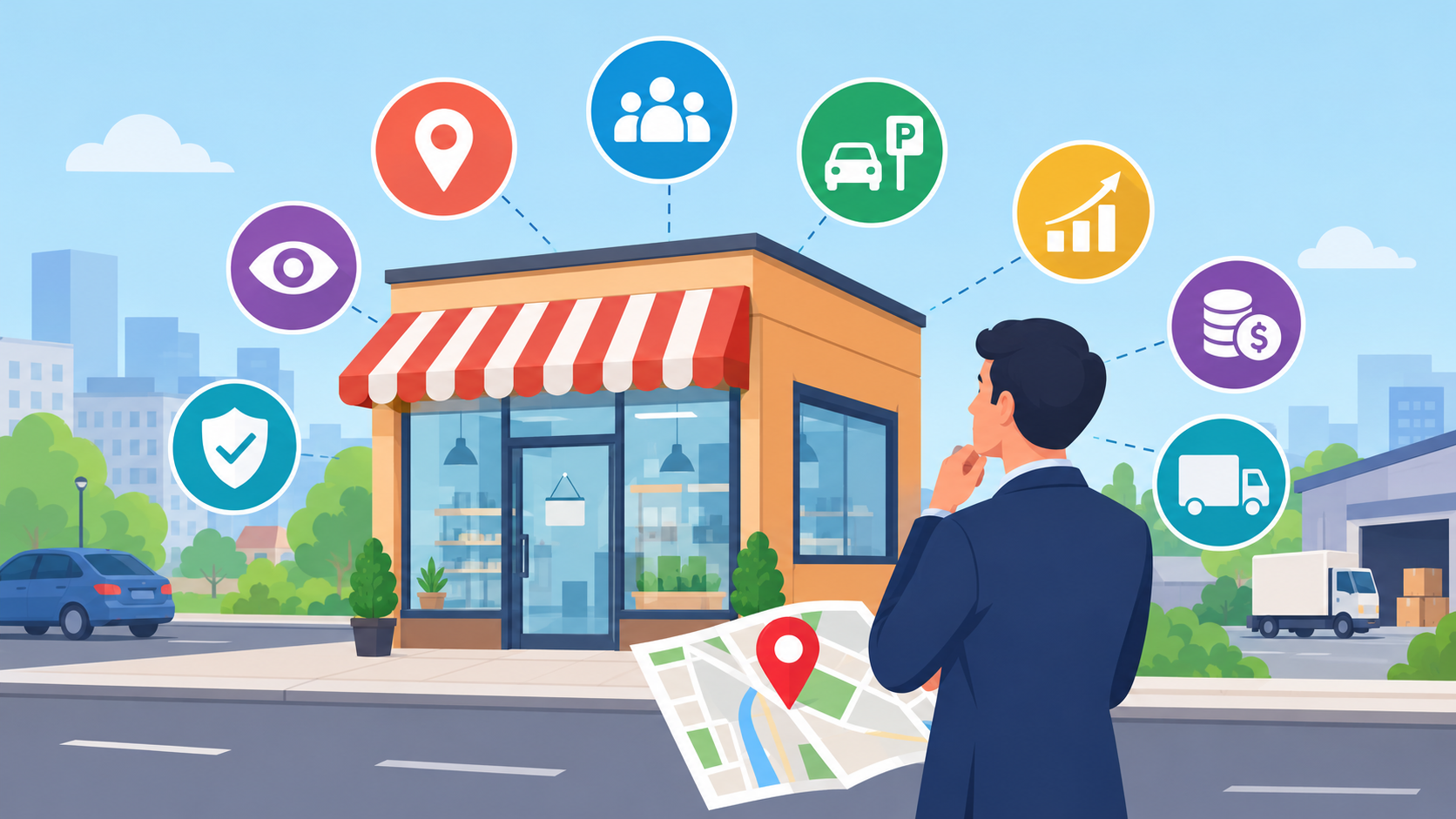
Choosing the best location for your business can have a major impact on visibility, customer traffic, operating costs, and long-term growth. Whether you are opening a retail store, service office, restaurant, or another customer-facing business, the right location should match your target customers, business needs, budget, and daily operations.
A great business location is more than a busy street or attractive storefront. You need to consider accessibility, competition, demographics, parking, transportation, suppliers, employees, utilities, and the overall cost of operating in the area.
Before signing a lease or purchasing commercial property, take time to evaluate how a potential location supports your business goals. A little research upfront can help you avoid expensive problems later.
The first step in choosing a business location is understanding exactly what your business requires. The best location for one company may be completely unsuitable for another.
For example, a retail store may depend heavily on walk-in customers and storefront visibility. A professional service company may need a convenient office but receive most customers through appointments. A business that sells products online may prioritize warehouse access and shipping infrastructure over foot traffic.
Start by making a list of your operational requirements. Consider the questions below:
Your answers will help narrow down the types of properties and neighborhoods that make sense for your business.
If you are still developing the financial side of your business, understanding how to manage small business finances effectively can also help you establish a realistic budget before committing to a location.
A business location should make sense from your customer’s perspective. Even an affordable property can become a poor investment if your target customers rarely visit the area.
Start by defining who your ideal customers are. Consider their age, income, occupation, lifestyle, purchasing habits, and location. Then determine whether the area you are considering has enough potential customers to support your business.
Population data can help you understand whether a location matches your target market.
Look at factors such as:
The U.S. Census Bureau provides demographic and geographic information that can help businesses understand local communities and evaluate potential markets.
However, population size alone is not enough. A neighborhood with a large population may still be a poor fit if most residents are outside your target market.
Think about how customers will actually interact with your business.
If you operate a retail store, customers may value convenience, parking, visibility, and nearby businesses. If you provide professional services, customers may prioritize easy appointments, accessibility, and a convenient commute.
For businesses selling products or services remotely, the physical location may matter less to customers but more to employees, suppliers, and delivery operations.
The right location is ultimately the one that supports the way your customers prefer to buy from you.
Accessibility is one of the most important factors when evaluating a business location.
Customers and employees should be able to reach the property without unnecessary difficulty. A location that looks excellent on a map may become inconvenient during rush hour, bad weather, or busy periods.
Consider the following:
Your customers are not the only people who need convenient access to your business.
Employees who spend excessive time commuting may experience additional stress and transportation costs. Difficult access can also make recruiting more challenging, particularly when you are competing with businesses located in more convenient areas.
Before choosing a location, consider where your employees are likely to live and how easily they can reach the workplace.
High traffic can be valuable, but it does not automatically mean a location is right for your business.
A storefront on a busy road may receive thousands of passing vehicles but very few customers if drivers cannot easily enter the property. Similarly, a pedestrian-heavy area may not provide meaningful value if your business does not depend on walk-in customers.
Look beyond the traffic count and ask:
A location should have the type of traffic that matches your customer acquisition strategy.
Understanding nearby competition can tell you a lot about a potential market.
For some businesses, having competitors nearby can be beneficial because customers already recognize the area as a destination for a particular product or service. For others, entering an oversaturated market may make it harder to attract customers.
Research businesses offering similar products or services in the area.
Look at:
The goal is not necessarily to avoid every competitor. Instead, determine whether there is enough demand and identify what your business can do differently.
For example, if several businesses offer similar products, you could compete through better service, pricing, convenience, product selection, specialized expertise, or a stronger customer experience.
Businesses that sell primarily online may have different location considerations. Understanding ways to increase online sales for your business can help determine whether you need a high-traffic storefront or whether a more affordable operational location would be sufficient.
A location should fit your budget as well as your growth plans.
Rent or mortgage payments are only part of the total cost. Before committing to a property, estimate all recurring and one-time expenses associated with operating there.
These may include:
A cheaper property is not always the better option. If customers cannot find you, employees struggle to reach the workplace, or deliveries are expensive, the lower rent may not compensate for the disadvantages.
At the same time, paying a premium for a prestigious location may not make sense if your customers do not value the location.
The goal is to find the strongest balance between cost and business value.
Your location should support your supply chain.
If your business receives regular deliveries, determine whether suppliers can easily access the property. Check loading zones, delivery hours, road conditions, parking restrictions, and building access.
Transportation costs can increase significantly when suppliers or distribution centers are far away.
This is particularly important for businesses that handle large amounts of inventory, heavy products, food, equipment, or other physical goods.
Before signing a lease, ask how deliveries are handled and whether there are restrictions that could interfere with your operations.
If your business relies on selling connectivity-related products or services, operational efficiency is also important. For example, companies working with internet and telecommunications offerings need a location and infrastructure that allow employees to communicate with customers and manage daily activities effectively.
A business location needs more than four walls and a convenient address.
Check whether the property has reliable access to the infrastructure your business requires. Depending on your operations, this could include electricity, water, sewer, internet, phone service, gas, and other utilities.
Ask about:
Infrastructure problems can become expensive after you move in, so investigate them before signing an agreement.
For many customer-facing businesses, visibility can contribute directly to brand awareness.
A storefront that is easy to see from a busy road or pedestrian area can expose your brand to potential customers every day. Effective signage can also help existing customers locate your business more easily.
When comparing properties, consider:
Before assuming you can install a large sign, check local regulations and property restrictions. A location may appear ideal until you discover that the signage you planned is not permitted.
Customers and employees should feel comfortable visiting your business.
Research the surrounding neighborhood and evaluate factors such as lighting, pedestrian activity, property conditions, traffic safety, and the general condition of nearby businesses and public spaces.
Visit the area at different times of the day. A location can feel completely different during business hours, evenings, weekends, and rush hour.
If possible, talk to nearby business owners about the area. They may provide practical information about traffic, customers, property management, seasonal changes, and other factors that are difficult to discover through online research alone.
A location that works today may not work two or three years from now.
Before committing, think about where you expect your business to be in the future. You may need additional employees, more inventory, larger customer areas, additional parking, or expanded operations.
Ask yourself:
Future growth is especially important when signing a long-term lease. Moving an established business can be expensive and disruptive, so choosing a location with room to grow can provide significant value.
The surrounding business environment can influence your company’s long-term prospects.
Look for signs of development, new construction, population growth, infrastructure improvements, and changes in commercial activity. A neighborhood undergoing positive development could provide new customers over time.
However, construction can also create temporary challenges.
Consider both the short-term and long-term effects of planned projects. Road construction, new developments, zoning changes, or major infrastructure projects could affect access and visibility.
Researching the area’s future can help you avoid making a decision based only on current conditions.
One of the biggest mistakes business owners can make is falling in love with the first property they see.
Instead, create a simple comparison system for every location you are considering.
You can score each property based on:
| Factor | Questions to Consider |
|---|---|
| Customer Access | Can your target customers reach you easily? |
| Visibility | Can customers easily see your business? |
| Parking | Is there enough convenient parking? |
| Competition | Is the competitive environment manageable? |
| Cost | Does the location fit your budget? |
| Employees | Can employees commute conveniently? |
| Deliveries | Can suppliers access the property easily? |
| Infrastructure | Are utilities and internet reliable? |
| Growth | Can the business expand in the future? |
| Safety | Does the surrounding area support a comfortable environment? |
Giving each location a score can make the decision more objective.
You can also compare the expected benefits against the total operating costs rather than looking only at rent.
Online research is useful, but it should not replace an in-person visit.
Visit each potential location several times and at different times of day. Pay attention to traffic, noise, parking, pedestrian activity, nearby businesses, and how easy it is to enter and leave the property.
Try visiting during both busy and quiet periods.
If possible, visit on weekdays and weekends. This can reveal patterns that you might miss during a single property tour.
A location that looks perfect at 10 a.m. on a Tuesday could be completely different at 6 p.m. on a Friday.
Before signing anything, carefully review the lease and understand what you are actually agreeing to.
Important factors can include lease duration, rent increases, maintenance responsibilities, renewal options, permitted business activities, signage restrictions, renovation requirements, and termination provisions.
Make sure the property is legally suitable for your intended business.
Depending on the type of business and location, you may also need specific licenses, permits, zoning approval, or inspections.
Professional legal and commercial real estate advice can be valuable before making a significant long-term commitment.
A strong business location can make everyday operations easier while improving your ability to attract and retain customers.
Convenient transportation can help employees arrive on time. Accessible roads can make deliveries more efficient. Good visibility can increase brand exposure. Nearby businesses can create additional customer traffic. A growing neighborhood can provide opportunities for future expansion.
On the other hand, a poor location can create problems that are difficult and expensive to fix.
Customers may avoid an inconvenient property. Employees may struggle with commuting. Suppliers may charge more for deliveries. Limited parking can discourage visits. Poor visibility can increase the amount you need to spend on marketing.
This is why location should be treated as a strategic business decision rather than simply a real estate decision.
If you are also evaluating your company’s financial position, understanding financial planning strategies for small businesses can help you determine how much you can realistically invest in your location.
Location affects more than rent.
Transportation, utilities, employee commuting, maintenance, inventory management, marketing, and customer acquisition can all be influenced by where your business operates.
For example, a cheaper location far from customers may reduce rent but increase marketing and transportation expenses. A more expensive location with strong customer traffic could potentially reduce the amount of effort required to attract customers.
This is why business owners should evaluate the total cost of the location, not just the monthly lease payment.
Your working capital also needs to support the location. Understanding how working capital supports small business operations can help you plan for the cash required to cover everyday expenses after opening.
Choosing the best location for a business requires more than finding an affordable property in a busy area.
The right location should match your customers, employees, suppliers, budget, operations, and long-term growth plans. It should make it easy for customers to reach you while giving your team the infrastructure needed to operate efficiently.
Take time to research the market, compare competing businesses, study traffic and demographics, calculate the full cost of each property, and visit potential locations more than once.
A well-researched location can become a valuable business asset. More importantly, taking the time to choose carefully can help you avoid the cost and disruption of moving later.
The most important factor depends on your business model, but customer accessibility is often critical for customer-facing businesses. Your location should be convenient for the people you want to serve while also supporting your operational requirements.
Research local population, demographics, income levels, employment, consumer behavior, and population growth. Compare this information with your target customer profile to determine whether the area has enough potential demand.
No. High traffic is valuable only when it is relevant to your business. A location with heavy vehicle traffic but poor visibility or difficult access may perform worse than a quieter location that is convenient for your target customers.
Not necessarily. Competitors can indicate that customers already visit the area for similar products or services, but too much competition can also make customer acquisition difficult. Analyze demand, pricing, customer reviews, and what you can offer differently.
There is no universal percentage that works for every business. Your location costs should fit your revenue expectations, operating budget, cash flow, and growth plans. Consider rent alongside utilities, maintenance, insurance, transportation, taxes, and other expenses.
Parking can directly affect customer convenience. If customers cannot easily park near your business, they may choose another company instead, particularly for purchases or services that require longer visits.
Both matter. Customer-facing businesses may prioritize customer accessibility, while companies that operate primarily through appointments, online sales, or remote services may place more emphasis on employee access, suppliers, infrastructure, and operating costs.
There is no fixed number, but comparing several realistic options can help you identify differences in cost, accessibility, competition, visibility, and long-term potential. Avoid making a major commitment based on the first property that looks attractive.

Why Become an Internet Provider Dealer? 7 Key Benefits
Oct 13, 2026

Veterans Guide to Small Business Loans and Funding
Oct 12, 2026

How to Boost Consumer Conversion, Acquisition, and Retention
Oct 9, 2026
How to Choose the Best Location for Your Business
Oct 8, 2026

Must-Have Sales Training Tools for Your Business
Oct 7, 2026

12
Oct, 2026
FINANCE
Starting a business after military service can be an exciting way to build financial independence...
29
Sep, 2026
FINANCE
If you are thinking about applying for a personal or business loan, it is important...

22
Sep, 2026
FINANCE
Starting a business requires more than a good idea. You also need enough capital to...