DEALER
How to Manage Cash Flow in a Telecom Dealership Business
Managing cash flow in a telecom dealership means making sure your business has enough available...
Learn More

 October 30, 2026
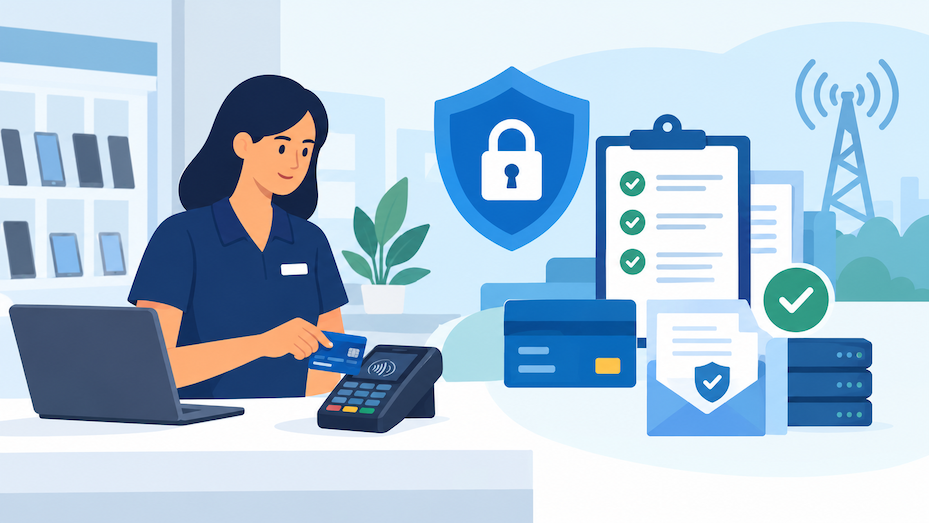
Telecom dealers handle customer information, service applications, and business transactions that may involve sensitive payment details. If your dealership accepts, processes, stores, or transmits payment card information, understanding PCI compliance is essential to protecting customers and meeting applicable payment security requirements.
PCI compliance for telecom dealers means following the Payment Card Industry Data Security Standard (PCI DSS) and completing the appropriate validation process based on how your business handles payment information. Depending on your payment setup and provider requirements, this may involve completing a Self-Assessment Questionnaire (SAQ), submitting an Attestation of Compliance (AOC), and obtaining vulnerability scan reports.
For dealers working with multiple telecom providers, payment processors, and business partners, having the right documentation ready can also help prevent unnecessary onboarding delays and compliance-related issues.
PCI compliance is the process of protecting payment card information according to the Payment Card Industry Data Security Standard (PCI DSS). It applies to organizations that store, process, or transmit payment card data, as well as certain organizations that can affect the security of payment card environments.
For telecom dealers, this matters because customer transactions may involve payment information when purchasing services, equipment, or other products. Proper security practices help reduce the risk of unauthorized access, payment fraud, and data breaches.
PCI DSS stands for Payment Card Industry Data Security Standard. It is a set of technical and operational security requirements developed by the PCI Security Standards Council (PCI SSC) to protect payment account information.
The standard establishes security practices that organizations must follow when handling payment card data.
The current published standard is PCI DSS v4.0.1. Dealers should refer to the official PCI SSC document library for the latest applicable documentation.
Telecom dealers should take PCI compliance seriously because payment security affects customer trust, business operations, and relationships with payment partners.
Here are some important reasons:
Any organization that stores, processes, or transmits cardholder data or sensitive authentication data may fall within PCI DSS scope. This includes merchants, payment processors, and service providers involved in payment card transactions.
A telecom dealership does not automatically have the same compliance obligations as every other dealer. Its requirements depend on the payment activities it performs and the systems it uses.
Not every dealer handles payment card information directly, but that does not automatically mean the dealer has no PCI-related responsibilities.
Consider these common situations:
| Dealer payment arrangement | Potential PCI considerations |
|---|---|
| Dealer accepts card payments directly | The dealer may have merchant PCI DSS obligations. |
| Dealer uses a payment terminal | The terminal, network, and related payment environment may be in scope. |
| Dealer uses an online payment portal | The payment process and systems involved must be evaluated. |
| Dealer uses a third-party payment processor | Outsourcing payment processing may reduce scope, but does not automatically eliminate all responsibilities. |
| Dealer does not handle card payments | The dealer should confirm whether any other payment-related activity or contractual requirement applies. |
The exact validation requirements should be confirmed with the payment processor, acquiring bank, or other organization responsible for accepting compliance documentation.
Some business partners or provider onboarding processes may request PCI-related documentation before granting access to certain systems or services.
For example, a dealer may be asked to provide a compliance questionnaire, an Attestation of Compliance, or an external vulnerability scan report.
However, these requirements are not universal. A provider’s specific onboarding policy may differ from the requirements established by a payment card brand or acquiring bank.
Dealers should ask the requesting organization to clarify:
Getting these details before submitting documents can prevent delays caused by incomplete or incorrect paperwork.
PCI DSS establishes security requirements designed to protect payment card information throughout its lifecycle. The standard covers network security, data protection, vulnerability management, access controls, monitoring, and organizational security policies.
Telecom dealers should understand the following major security areas, particularly if they accept customer payments directly.
Dealers must protect cardholder information whenever it is stored, processed, or transmitted.
Recommended practices include:
One important rule concerns card verification codes, commonly called CVV or CVC.
PCI DSS prohibits retaining these security codes after authorization, even if they are encrypted. This restriction also applies when a customer gives permission to keep the code for future transactions.
For additional guidance, see the PCI SSC FAQ on storing card verification codes.
Payment environments must be protected against unauthorized access and security threats.
Telecom dealers that operate their own payment systems should work with qualified IT professionals or payment service providers to implement appropriate safeguards.
These may include:
Not every employee needs access to customer payment information.
Dealers should establish clear access permissions based on each employee’s responsibilities.
For example, a sales representative may need to submit customer service applications but should not automatically have access to stored payment card information.
Recommended access management practices include:
Security controls should be monitored and tested according to the applicable PCI DSS requirements.
Depending on the dealer’s environment and validation method, this may include vulnerability scans, security testing, log reviews, and other technical assessments.
External vulnerability scans may need to be performed by a PCI SSC Approved Scanning Vendor (ASV) when required.
Employees should understand how to handle customer payment information safely.
A dealership should maintain documented procedures covering:
Training is especially important when multiple representatives handle customer transactions. This also supports the quality control practices discussed in our telecom sales call quality assurance guide.
A Self-Assessment Questionnaire (SAQ) is a PCI DSS validation tool that eligible merchants and service providers can use to assess and document their compliance with applicable security requirements.
It contains questions about an organization’s payment environment, security controls, and handling of cardholder data.
The correct SAQ depends on the way payment information is accepted, processed, transmitted, or stored. Dealers should not select a questionnaire simply because it appears shorter or easier to complete.
Different SAQs are designed for different payment environments.
Some commonly referenced SAQ types include:
| SAQ type | General purpose |
|---|---|
| SAQ A | Certain card-not-present environments where all cardholder data functions are outsourced to PCI DSS-compliant third parties. |
| SAQ A-EP | Certain e-commerce environments where payment processing is outsourced but the merchant’s website can affect payment security. |
| SAQ B | Certain merchants using standalone, imprint-only or dial-out terminals without electronic cardholder data storage. |
| SAQ B-IP | Certain merchants using standalone IP-connected payment terminals. |
| SAQ C | Certain merchants using payment application systems connected to the internet. |
| SAQ C-VT | Certain merchants using virtual payment terminals on isolated computer systems. |
| SAQ P2PE | Certain merchants using validated point-to-point encryption solutions that meet the applicable eligibility criteria. |
| SAQ D | Other merchants or eligible service providers that do not qualify for another SAQ type. |
Important: This table is a general overview, not a tool for determining eligibility. Each SAQ has specific eligibility criteria, and not every category applies to every dealership.
The dealer’s acquiring bank, payment processor, or compliance-accepting entity should confirm the appropriate SAQ before the assessment begins.
Dealers can approach the SAQ process through the following steps:
The PCI SSC’s official SAQ guidance provides further information about this process.
An Attestation of Compliance (AOC) is a formal document that records an organization’s PCI DSS assessment or self-assessment results and the applicable validation details.
It is often requested alongside an SAQ or Report on Compliance (ROC), depending on the organization’s assessment method.
For telecom dealers, an AOC can serve as evidence that the business has completed the applicable PCI DSS validation process.
No. An SAQ and an AOC serve different purposes.
An SAQ contains the assessment questions and responses used by eligible organizations to evaluate their security controls.
An AOC records the applicable compliance validation information in a formal attestation document.
Here is a simple comparison:
| Document | Purpose |
|---|---|
| SAQ | Documents responses to applicable PCI DSS self-assessment questions. |
| AOC | Provides a formal attestation of the assessment results. |
| ROC | Documents the results of a formal PCI DSS assessment when required. |
| ASV Scan Report | Documents the results of an applicable external vulnerability scan. |
A dealer should confirm which documents the requesting organization actually requires. Completing an SAQ does not automatically mean every possible supporting document is required.
Depending on the applicable AOC template and assessment type, the document may include:
Dealers should use the official AOC associated with the applicable PCI DSS validation method rather than creating an informal replacement.
PCI vulnerability scans are technical security assessments used to identify weaknesses in systems and networks that may expose payment environments to security threats.
Certain PCI DSS validation methods require external scans performed by a PCI SSC Approved Scanning Vendor (ASV). However, not every dealer must submit the same scan reports.
Whether a scan is necessary depends on the dealer’s payment environment, applicable requirements, and validation instructions.
An external vulnerability scan examines internet-facing systems for security weaknesses that could expose an organization to attacks.
Depending on the applicable assessment, scans may identify:
A scan report helps organizations identify issues that need attention before they can demonstrate compliance.
A failed scan generally means that one or more identified security issues need to be reviewed and corrected.
Dealers should follow a structured remediation process:
Dealers should avoid submitting outdated or unsuccessful scan reports when a passing report is specifically required.
Keeping PCI-related documents organized makes compliance reviews easier and helps dealerships respond to requests from payment processors and business partners.
The required documents vary by payment setup, but the following checklist provides a useful starting point.
| Document | Purpose |
|---|---|
| Completed SAQ | Records the applicable self-assessment responses. |
| Attestation of Compliance | Documents the applicable compliance attestation. |
| ASV Scan Report | Provides evidence of required external vulnerability scanning. |
| PCI DSS Assessment Report | Documents formal assessment results when a ROC is required. |
| Payment Processing Information | Identifies the payment systems and service providers involved. |
| Security Policies | Documents internal payment security procedures. |
| Employee Access Records | Helps demonstrate appropriate access management. |
| Remediation Records | Tracks corrective actions for identified security issues. |
Not every dealer will need every document listed above. The requesting organization should provide the exact documentation checklist.
A simple document management system can help prevent missing or outdated submissions.
Consider organizing files into the following folders:
1. PCI Assessment
2. Vulnerability Testing
3. Internal Security
4. Renewal and Submission History
Dealers should also restrict access to sensitive compliance documents and avoid placing payment card data in ordinary email attachments or unsecured shared folders.
PCI compliance validation is generally performed at least annually for many merchants and service providers, but the exact validation frequency and reporting requirements are determined by the applicable compliance program.
Some organizations may also require additional assessments, scans, or updated documentation when their payment environment changes.
Telecom dealers should not assume that a previously submitted AOC or SAQ remains sufficient indefinitely.
A new assessment or documentation update may be necessary when:
Use a simple compliance tracking process:
A centralized compliance tracker is especially useful for dealerships that manage multiple provider relationships or locations.
Many compliance problems arise from incomplete documentation, poor access controls, or misunderstandings about how payment data is handled.
Avoiding these mistakes can make the validation process more manageable.
A common mistake is completing a questionnaire without confirming eligibility.
Different SAQs apply to different payment environments. Dealers should obtain confirmation from their acquiring bank or payment processor before selecting one.
Using an external payment processor can reduce the amount of cardholder data handled directly by a dealer.
However, outsourcing payment processing does not automatically eliminate the dealer’s PCI DSS responsibilities.
Dealers should understand their responsibilities and confirm that the payment service provider meets applicable security requirements.
Keeping card numbers, security codes, or other sensitive payment details in spreadsheets, email messages, or shared documents creates unnecessary risks.
Use approved payment systems and avoid storing information that the business does not need.
A failed vulnerability scan should not be treated as a minor administrative issue.
Dealers should investigate identified problems, correct them, and obtain updated scan results when required.
Employees should only receive access necessary to perform their assigned responsibilities.
Regularly reviewing account permissions can reduce the risk of unauthorized access.
A completed SAQ without a required AOC or scan report may not satisfy the requesting organization’s submission requirements.
Always confirm the complete documentation checklist before submitting.
Expired documentation can create additional administrative work and potentially delay required approvals.
Use reminders and assign responsibility for monitoring compliance dates.
A repeatable compliance process makes it easier to maintain payment security while keeping business operations organized.
Rather than treating PCI compliance as a one-time paperwork requirement, dealers should make it part of their regular operational procedures.
Start by identifying how your dealership handles payments.
Determine whether employees accept card payments, use payment terminals, access online payment portals, or work with third-party processors.
This helps establish the payment environment that needs to be evaluated.
Ask your payment processor or acquiring bank which PCI DSS requirements apply to your business.
Request clarification about the correct SAQ, AOC, scan requirements, and submission deadlines.
Evaluate employee access, payment processing systems, network security, and information handling procedures.
Identify weaknesses before beginning the formal assessment.
Prepare the applicable SAQ, AOC, and any additional reports requested by the compliance-accepting organization.
Make sure the information is accurate and reflects your actual business operations.
Work with qualified IT or security professionals to address any weaknesses discovered during the assessment or vulnerability scanning process.
Keep records of corrective actions and follow-up testing.
Create a schedule for reviewing payment systems, updating policies, checking access permissions, and preparing required validation documents.
A consistent process makes future assessments easier to manage.
PCI compliance supports dealership growth by establishing stronger payment security practices and improving operational readiness.
As a telecom dealership expands, it may work with more employees, additional payment systems, and multiple business partners. Having documented security procedures helps the business manage these responsibilities more effectively.
Consider these benefits:
Dealers planning to expand should also consider how compliance administration fits into their overall business planning. Our telecom dealer business plan guide offers additional guidance on preparing for dealership operations and long-term growth.
PCI DSS applies to organizations that store, process, or transmit payment card information, as well as certain organizations that can affect payment card data security. Whether a particular telecom dealer must complete a specific validation process depends on its payment activities and the requirements of the relevant payment brands, acquirer, or payment processor.
PCI certification is a commonly used informal term for demonstrating PCI DSS compliance. In practice, organizations generally validate compliance through an applicable assessment, SAQ, AOC, or Report on Compliance rather than receiving a universal government-issued PCI certificate.
An SAQ is a questionnaire used by eligible organizations to assess their compliance with applicable PCI DSS requirements. An AOC is the formal attestation document that records the relevant assessment results.
Not every telecom dealer requires an ASV scan. External vulnerability scanning is required in certain PCI DSS environments and validation methods. Dealers should confirm whether an ASV scan is necessary with their acquiring bank or compliance-accepting organization.
Yes. Dealers can use third-party payment processors to handle transactions. However, outsourcing payment processing does not automatically remove all PCI DSS responsibilities. Dealers should verify their processor’s compliance status and understand their own remaining obligations.
The timeline depends on the complexity of the payment environment, the applicable assessment, and whether security issues need to be corrected. A dealer with a straightforward payment setup may complete the required documentation more quickly than a business with multiple payment systems and technical requirements.
The consequences depend on the applicable payment agreements and compliance program. Potential consequences may include additional remediation requirements, contractual issues, increased security exposure, or restrictions on payment processing privileges. Dealers should address compliance gaps promptly and communicate with the relevant payment partner.
The PCI Security Standards Council website provides official standards, SAQs, AOCs, guidance documents, and frequently asked questions. Dealers should also contact their payment processor or acquiring bank to confirm their specific validation requirements.
Official resource: PCI Security Standards Council.
PCI compliance for telecom dealers is about more than completing a questionnaire or submitting paperwork. It involves understanding how your business handles payment information, protecting customer data, maintaining appropriate security controls, and keeping the required documentation current.
The best approach is to identify your payment environment, confirm the correct PCI DSS validation requirements, complete the applicable SAQ and AOC, and address any necessary vulnerability testing or security improvements.
For telecom dealers working with multiple providers and business partners, staying organized can also make compliance reviews and onboarding requirements easier to manage.
By treating payment security as an ongoing business responsibility, dealers can protect customers, strengthen business relationships, and build a more reliable foundation for long-term growth.
PCI Compliance for Telecom Dealers: A Practical Guide
Oct 30, 2026

How to Manage Cash Flow in a Telecom Dealership Business
Oct 29, 2026

How to Build Consumer Trust and Grow Your Brand
Oct 28, 2026

The Best Smartphones To Buy
Oct 27, 2026

Telecom Dealer Startup Costs: A Practical Budget Breakdown
Oct 26, 2026

29
Oct, 2026
DEALER
Managing cash flow in a telecom dealership means making sure your business has enough available...

23
Oct, 2026
DEALER
Selling business internet services to small businesses starts with understanding how a company uses the...

22
Oct, 2026
DEALER
Telecom sales call quality assurance is the process of reviewing sales conversations to ensure representatives...