DEALER
How to Handle Telecom Installation No-Shows and Rescheduling
A missed internet or telecom installation appointment can frustrate customers, delay service activation, and create...
Learn More

 November 17, 2026
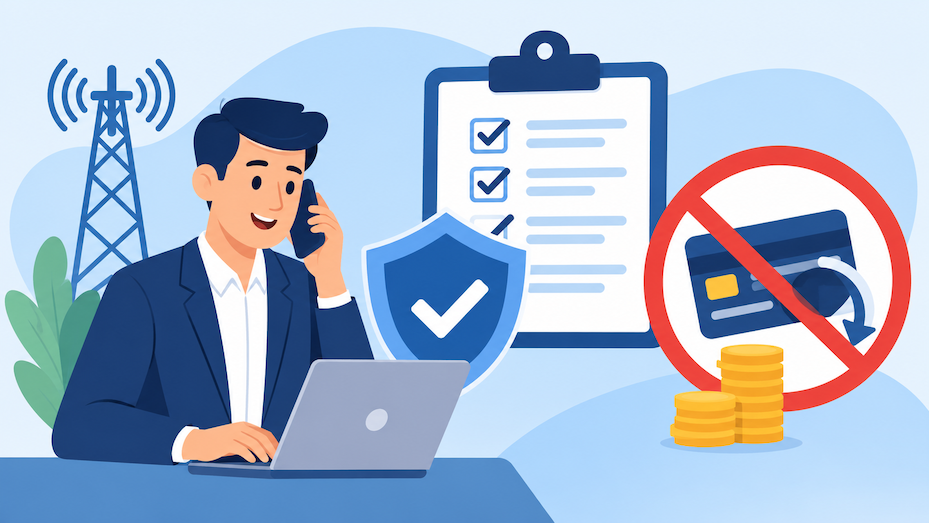
Chargebacks and disputed sales can create financial problems for telecom dealerships by reversing commissions, increasing administrative work, and damaging relationships with providers and payment processors. The most effective way to reduce these issues is to establish a consistent sales verification process, document customer authorization, explain service terms clearly, and monitor every order from submission through activation.
For telecom dealers, preventing chargebacks starts before a sale is submitted. Representatives must understand what customers are purchasing, confirm that the information is accurate, and make sure customers understand the pricing, service conditions, and commitments associated with their orders.
This guide explains why telecom chargebacks happen, how dealers can prevent disputed transactions, what documentation to maintain, and how to build a repeatable process that protects dealership revenue.
Telecom dealer chargebacks occur when previously credited commissions or payments are reversed under applicable provider or payment agreements. Disputed sales happen when a customer, payment provider, or business partner questions the legitimacy, accuracy, authorization, or terms of a transaction.
Although these issues are related, they are not always the same.
A chargeback may result from a customer canceling a service within a specified period, an invalid transaction, or a contractual commission reversal. A disputed sale may involve an unauthorized order, incorrect pricing, misleading sales information, or a disagreement about what the customer agreed to purchase.
Understanding the difference helps dealers determine the appropriate corrective action.
Chargebacks and disputed sales involve different processes and potential consequences.
| Issue | What It Means | Possible Business Impact |
|---|---|---|
| Commission chargeback | Previously credited commission is reversed under provider terms | Reduced dealer earnings |
| Payment chargeback | A cardholder disputes a payment through their financial institution | Reversed payment and possible processing fees |
| Unauthorized sale | A transaction was submitted without valid customer permission | Financial and compliance exposure |
| Incorrect order | Submitted information does not match the customer’s requested service | Rework, cancellation, or commission adjustment |
| Misrepresented sale | Customer claims the service or pricing was inaccurately explained | Complaints and potential disputes |
| Early cancellation | Customer cancels within a period that may trigger a contractual reversal | Potential commission loss |
Not every canceled order automatically results in a chargeback. The outcome depends on the provider agreement, payment arrangement, transaction circumstances, and applicable policies.
Dealers should distinguish provider commission reversals from payment card chargebacks because the investigation procedures and documentation requirements can differ.
Telecom dealers experience chargebacks for several reasons, including unauthorized transactions, inaccurate customer information, unclear pricing explanations, early cancellations, and failure to follow provider procedures.
Most preventable problems begin with weaknesses in the sales process.
Incorrect customer details can create problems during order verification and service activation.
Common examples include:
Representatives should review customer information before submitting an order rather than relying on assumptions or incomplete records.
A telecom order should only be submitted when the customer has clearly authorized the transaction.
Problems can occur when representatives submit applications without obtaining proper approval or when customers do not understand that an order has been placed.
Before submission, confirm that the customer has agreed to the selected provider, service package, pricing, and relevant terms.
Pricing misunderstandings are a common source of customer dissatisfaction.
A customer may expect one monthly rate but later discover that the amount changes after a promotional period or that additional equipment and installation charges apply.
Representatives should explain:
Never present temporary promotional pricing as a permanent monthly rate.
Duplicate applications and incorrect service submissions can create unnecessary complications.
For example, a representative may accidentally submit the same order twice or select a service package that does not match the customer’s request.
A pre-submission review helps identify these problems before they reach the provider.
Some telecom provider agreements include commission reversal provisions when customers cancel services within a specified period.
Early cancellations may occur because of:
Dealers should review the applicable provider agreement to understand cancellation windows, commission eligibility, and reversal conditions.
Fraudulent transactions can involve stolen payment information, identity misuse, false customer details, or orders submitted without the legitimate account holder’s approval.
These situations require careful handling and appropriate escalation through provider and payment processing channels.
Dealers should never bypass verification procedures simply to increase sales volume.
Telecom dealers can reduce chargebacks by introducing clear verification procedures, accurate order documentation, transparent customer communication, and regular transaction monitoring.
The following strategies provide a practical framework for preventing avoidable disputes.
Customer verification should be a standard requirement for every transaction.
Representatives should confirm that the information provided matches the customer and the service being requested.
A basic verification process should include:
Use only approved verification methods and collect only the information necessary to complete the transaction.
Every order should have a documented record showing that the customer agreed to the transaction.
Depending on the provider’s requirements, acceptable records may include:
Representatives should not rely solely on verbal assumptions or informal conversations when the provider requires a specific authorization method.
The objective is to establish a clear record of what the customer approved and when the authorization was obtained.
Transparent communication reduces the likelihood of billing-related disputes.
Before submitting an order, representatives should explain the complete pricing structure rather than focusing only on the advertised promotional rate.
For example, a customer considering an internet package should understand:
Ask customers whether they understand the terms before moving forward.
This simple step can prevent misunderstandings that might otherwise result in cancellations or disputes.
An order review process helps identify mistakes before submission.
Dealers should implement a checklist that representatives complete before sending applications to providers.
Recommended pre-submission checks include:
Managers can also review selected orders, particularly those involving unusual circumstances or higher transaction values.
Preventing chargebacks does not end when an application is submitted.
Dealers should monitor orders throughout the processing and activation stages to identify problems early.
A post-submission workflow should include:
For a more detailed approach to accurate submissions, see JNA’s Telecom Order Submission Checklist for Faster Activation.
Customer communication should continue after the initial transaction.
A follow-up gives customers an opportunity to ask questions, report problems, and confirm that the service matches their expectations.
A practical follow-up process can include:
Dealers should use appropriate communication methods and respect customer consent and contact preferences.
For more guidance, see JNA’s article on How Telecom Dealers Can Spot and Prevent Customer Churn.
Telecom dealers should maintain accurate transaction records that demonstrate customer authorization, the terms explained during the sale, and the actions taken throughout the order process.
Organized documentation makes it easier to investigate complaints and respond to legitimate disputes.
The following documentation can help support transaction reviews:
| Document or Record | Purpose |
|---|---|
| Customer authorization | Demonstrates approval of the transaction |
| Signed service agreement | Records accepted terms and conditions |
| Order confirmation | Shows the services requested |
| Pricing information | Documents the quoted service and applicable charges |
| Communication history | Provides context for customer interactions |
| Provider order reference | Helps identify and track the transaction |
| Installation or activation confirmation | Records the final service status |
| Cancellation records | Documents customer requests and cancellation dates |
| Dispute correspondence | Preserves relevant investigation details |
| Representative identification | Helps establish who handled the transaction |
The exact records required depend on the provider, transaction type, and applicable legal and contractual requirements.
Document retention periods depend on provider agreements, applicable laws, payment processing requirements, and business policies.
Dealers should establish a written retention schedule that specifies:
Do not retain sensitive customer or payment information longer than necessary.
For payment-related security practices, refer to JNA’s PCI Compliance for Telecom Dealers: A Practical Guide.
When a chargeback or disputed sale occurs, dealers should review the transaction, identify the reason for the dispute, gather supporting records, and follow the applicable provider or payment processor investigation procedure.
Responding quickly and providing accurate documentation can help prevent avoidable delays.
Start by determining why the transaction was challenged.
Possible reasons include:
Do not assume every dispute is fraudulent or that every customer complaint is invalid.
Review the available facts first.
Collect relevant records associated with the transaction.
Depending on the dispute, these may include:
Only submit information requested through the authorized dispute process.
Payment processors and providers may establish specific response deadlines.
Missing a deadline can affect the ability to challenge a dispute or provide additional documentation.
Record the notification date, response deadline, responsible employee, and current investigation status.
Prepare a clear explanation supported by relevant documentation.
Avoid submitting unrelated records, making unsupported claims, or altering transaction information.
If the customer is correct, follow the appropriate correction, cancellation, or refund procedure rather than attempting to dispute a legitimate complaint.
Record whether the dispute was resolved, accepted, rejected, or escalated.
Include the final outcome in the dealership’s transaction records so managers can identify recurring problems.
Sales representative training is one of the most effective ways to reduce preventable transaction problems.
Every representative should understand the dealership’s verification process, customer communication standards, documentation requirements, and provider-specific order procedures.
A practical training program should include the following areas:
Customer verification
Product and pricing knowledge
Order accuracy
Customer communication
Dispute handling
Managers should review sales activity regularly rather than waiting for a chargeback to occur.
Useful review activities include:
JNA’s guide to Why Telecom Sales Get Rejected and How to Fix Them provides additional insight into improving sales accuracy and reducing avoidable processing problems.
Telecom dealers should monitor chargeback activity alongside cancellations, order accuracy, and dispute resolution performance. These measurements help managers identify patterns and determine whether preventive improvements are working.
| Metric | What It Measures | Why It Matters |
|---|---|---|
| Chargeback rate | Chargebacks relative to eligible transactions or commissions | Identifies reversal trends |
| Disputed transaction rate | Transactions challenged during a reporting period | Highlights customer dispute patterns |
| Order error rate | Orders containing incorrect or incomplete information | Measures submission accuracy |
| Authorization completion rate | Transactions with required authorization records | Evaluates documentation consistency |
| Early cancellation rate | Eligible orders canceled within a defined period | Identifies potential sales quality issues |
| Dispute resolution time | Time required to resolve reported disputes | Measures investigation efficiency |
| Repeat dispute rate | Customers or transaction types associated with recurring disputes | Highlights underlying process problems |
The calculation depends on what the dealership is measuring. One practical approach is to compare reversed commissions with the total eligible commissions for the same reporting period.
Use this formula:
Commission Chargeback Rate =
(Reversed Eligible Commissions / Total Eligible Commissions) × 100
For example, assume a dealership receives $20,000 in eligible commissions during a reporting period and experiences $1,000 in commission reversals.
($1,000 / $20,000) × 100 = 5%
The commission chargeback rate is 5%.
This is an illustrative management calculation, not a universal provider reporting standard. Dealers should follow their provider’s definitions and compare equivalent reporting periods.
For a broader view of operational performance, see JNA’s guide to Telecom Dealer KPIs: Metrics That Drive Better Results.
Dealers can reduce unnecessary disputes by avoiding sales practices that create confusion, incomplete records, or unauthorized transactions.
Here are common mistakes to watch for.
Submitting more applications does not necessarily mean generating more successful business.
Representatives should prioritize legitimate, properly authorized transactions over rushing through applications to meet sales targets.
Never guarantee a price, discount, installation date, or service feature without confirming that the provider offers it.
Incorrect promises can create customer dissatisfaction and potential disputes.
A customer should understand the selected service and authorize the order before submission.
Do not assume that an inquiry or expression of interest is permission to complete a transaction.
Important sales details should be recorded through approved business systems.
Without documentation, managers may struggle to determine what was explained or agreed upon when a customer raises a complaint.
Repeated billing questions, installation complaints, cancellation inquiries, and customer dissatisfaction should receive appropriate attention.
Addressing concerns early may prevent a legitimate service issue from escalating into a dispute.
When each representative follows a different process, transaction quality becomes difficult to manage.
Standardized procedures help ensure that every customer receives accurate information and every order follows the same basic verification requirements.
A chargeback prevention checklist gives representatives and managers a consistent way to review transactions before and after submission.
Dealers can adapt the following checklist to their provider agreements and internal procedures.
A consistent review process helps dealers identify problems before they affect a larger number of transactions.
Common causes include unauthorized transactions, early cancellations, inaccurate customer information, duplicate orders, pricing misunderstandings, and violations of provider or payment agreements. The specific reason depends on the transaction and applicable contract terms.
Dealers can reduce preventable commission reversals by verifying customer information, explaining service terms accurately, obtaining proper authorization, submitting complete orders, and monitoring cancellations. They should also understand each provider’s commission reversal policy.
In many cases, dealers can request a review or submit supporting documentation when they believe a commission reversal is incorrect. The process and eligibility depend on the provider agreement. Dealers should follow the applicable dispute procedure and response deadlines.
Depending on the dispute, supporting evidence may include signed agreements, customer authorization, order confirmations, pricing disclosures, communication records, and installation or activation details. The required evidence depends on the type of dispute and the organization reviewing it.
No. A cancellation does not automatically result in a commission reversal. Some provider agreements include specific eligibility periods and conditions, while others may have different rules. Dealers should review the applicable commission schedule and agreement.
Representatives should explain service terms clearly, verify customer information, obtain authorization, avoid unsupported promises, and maintain accurate transaction records. Clear communication before submission is particularly important.
Yes. Chargebacks and cancellations represent different business events and should be tracked separately. A cancellation may or may not result in a commission reversal, depending on the applicable provider agreement.
Dealers should monitor disputes as they occur and review trends regularly, such as monthly. Higher-volume dealerships may benefit from more frequent reviews to identify recurring issues by provider, service type, or sales representative.
Reducing telecom dealer chargebacks requires more than responding to reversed commissions after they happen. It starts with accurate customer verification, transparent pricing explanations, documented authorization, and consistent order management.
Dealers should also invest in representative training, monitor customer concerns, and maintain organized transaction records. These practices help identify preventable mistakes and make it easier to investigate legitimate disputes.
Most importantly, focus on the quality of every transaction rather than sales volume alone. A properly verified and documented sale creates a stronger foundation for customer satisfaction, provider relationships, and sustainable dealership revenue.
How to Handle Telecom Installation No-Shows and Rescheduling
Nov 18, 2026
How Telecom Dealers Can Reduce Chargebacks and Disputed Sales
Nov 17, 2026
Why Telecom Orders Get Delayed and How Dealers Can Fix Them
Nov 16, 2026

How to Explain Internet Speeds to Customers Clearly
Nov 13, 2026

How Telecom Dealers Can Win More Local Customers
Nov 12, 2026

18
Nov, 2026
DEALER
A missed internet or telecom installation appointment can frustrate customers, delay service activation, and create...
16
Nov, 2026
DEALER
Telecom order delays can happen when providers need additional verification, service availability confirmation, technical review,...
13
Nov, 2026
DEALER
When customers compare internet plans, they often hear terms like Mbps, bandwidth, download speed, upload...