DEALER
Telecom Lead Management: Follow Up Without Losing Sales
Telecom lead management is the process of organizing, qualifying, contacting, and following up with potential...
Learn More

 July 31, 2026
T-Mobile has become the biggest name in U.S. wireless. Since merging with Sprint, the carrier has grown its customer base past every rival, and its 5G network keeps landing at the top of independent speed tests. For entrepreneurs, that growth creates a real opening: a chance to sell one of the strongest telecom brands in the country.
This guide covers what the T-Mobile dealer program actually involves, the different routes you can take, the requirements and costs, and how much you can realistically earn. By the end, you’ll know exactly what it takes to get approved and whether it fits your business.
The term covers more than one model. T-Mobile runs several partner tracks, and picking the right one matters more than anything else you’ll decide upfront. The good news is there’s a route for almost every budget and skill set.
The most recognizable route. Premium Retailers (TPRs) operate T-Mobile-branded stores that look and feel like corporate locations, but they’re independent businesses. T-Mobile supplies the brand, the product lines, the training and the commission structure. You supply the capital, the location, the staff and the daily management.
This is a full retail commitment, and it’s what most people picture when they search for T-Mobile dealer. It’s also the highest-stakes route, with the biggest upfront investment and the most demanding store standards.
Metro is T-Mobile’s prepaid brand, and it runs a separate dealer program. You open a Metro-branded store, sell prepaid plans, phones and accessories, and operate as an independent owner. The program explicitly is not a franchise, so there are no franchise fees or royalties, though you still follow Metro’s store guidelines.
Startup costs tend to run lower than a postpaid T-Mobile store, which makes Metro a popular entry point for first-time telecom owners.
This is the reseller route. Instead of a storefront, you sell T-Mobile’s business plans, devices and solutions to companies as a registered partner. The program brings deal registration, co-marketing funds, training and tiered compensation, and it’s built for consultants, IT providers, VARs and sales teams that already serve business clients.
If you already have a B2B customer base, this is often the smartest way to add wireless revenue without carrying inventory. T-Mobile handles device shipping and billing directly to your customers, so your only job is selling.
Each of these models works differently, and understanding the broader landscape helps. Our breakdown of the different types of dealer programs and how they operate explains where each one fits.
Let’s talk about demand, because that’s what pays your bills. T-Mobile serves more than 100 million customers across its brands, and it’s been marketing itself as America’s largest 5G network for years. Independent testing from Ookla has repeatedly ranked its coverage and speeds at or near the top of the U.S. market.
That matters for a dealer more than you might think. A strong brand does the heavy lifting in sales. Customers walk in already half-convinced, so you’re not explaining why they should switch to an unknown carrier. You’re helping them choose the right plan on a network they already trust.
That built-in trust is exactly why becoming a telecommunications dealer beats building a business from a blank slate. You inherit the brand’s reputation and spend your energy on service instead of awareness.
T-Mobile doesn’t publish one public checklist, and requirements shift by route and region. But across every track, the same fundamentals keep coming up.
You’ll need a registered business, typically an LLC or corporation, with a federal EIN. T-Mobile contracts with businesses rather than individuals, and every route involves a formal agreement with background and financial checks.
Retail storefronts demand serious startup capital. Build-out, inventory, deposits, payroll reserves and working capital add up fast, and T-Mobile’s approval process includes a review of your liquidity. Six-figure budgets are normal for full TPR locations.
The business partner route is the lighter option. Many resellers start with little to no inventory cost because T-Mobile and its distributors handle fulfillment and billing.
Storefront routes require an approved location with proper retail zoning, visibility and a footprint that fits brand standards. And sales experience matters more than applicants often expect. T-Mobile wants operators who can hire, train and manage a team, not investors chasing passive income.
The honest answer is that it depends almost entirely on the route you choose.
A full T-Mobile Premium Retailer storefront is a six-figure undertaking. You’re paying for a lease, a complete branded build-out, a starter inventory of phones and accessories, plus enough working capital to cover payroll and bills until commissions catch up. Some operators open multiple locations from day one, which pushes the number much higher.
A Metro by T-Mobile store still requires real capital, but the bar is meaningfully lower. Leases, build-out and inventory are more modest, which is why so many dealers start with Metro and add a postpaid store later.
The T-Mobile for Business partner route is the outlier, and a pleasant one. Registration is free, there’s no storefront, and since T-Mobile ships devices and bills customers directly, your costs are mostly your own time and marketing.
Whatever route you pick, undercapitalizing is the fastest way to fail. Our guide on maximizing profitability as a telecom dealer is worth reading before you commit, because it lays out the numbers you should be planning around.
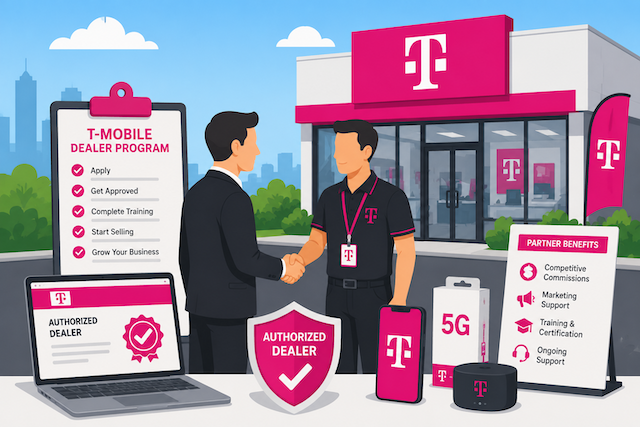
The application process varies by route, but the general flow looks like this:
Be patient through this process. Approval can take several months, and rushing it, or submitting incomplete documentation, only adds delay.
Dealer income is built on commissions. You earn on activations, device sales, accessory margins and, in many cases, residuals that keep paying as long as customers stay on the network.
The residuals are the part most new dealers underestimate. A single activation pays once, but a customer who stays for two years keeps generating revenue the whole time. That’s why established stores with large customer bases are so much more valuable than new ones.
Exactly how those numbers work depends on your agreement, and it’s worth understanding how telecom dealer commissions are structured before you sign anything. Ask about activation fees, residuals, spiffs and chargebacks during negotiation, and get the answers in writing.
T-Mobile brings the strongest consumer brand in wireless, and that’s a genuine advantage. The trade-off is retail intensity, competitive store density, and commission structures that reward volume.
Internet and home security dealer programs, by contrast, often have lower entry costs and steadier recurring revenue, though the products are less exciting to sell. A lot of operators don’t choose at all. They sell multiple brands from one store, which spreads risk and smooths out revenue.
That’s the approach our own reseller program is built around, and it’s why multi-brand dealers tend to weather slow months better than single-carrier stores.
Getting approved is the easy part. Staying profitable is the real work, and a few habits separate thriving stores from struggling ones.
Train your team on the network, not just the plans. Customers ask about coverage, speeds, trade-ins and switching. A staff member who can answer confidently closes more sales than one who reads from a script.
Treat accessories as a profit center. Phone sales and activations get the attention, but accessories carry some of your best margins. Every checkout should naturally include cases, chargers and screen protection.
Own your local marketing. The carrier’s brand brings people in, but it won’t run your store’s social media or chase local business customers. Practical steps for getting more customers into your store make a measurable difference in a market where competitors are often a few blocks away.
Stay on top of compliance. Telecom retail is heavily regulated, and violations cost money and credibility. Familiarize yourself with the consumer protection laws that apply to cell phone dealers before you take your first customer.
Track your numbers weekly. Activations, attachment rates, average ticket, chargebacks. If you’re not reviewing these every week, you’re managing on feelings.
The dealer landscape has its share of cautionary tales, and they cluster around a few predictable errors.
Underestimating working capital. New stores routinely run several months before commissions reach steady state. If you can’t cover that gap, you’ll be selling under pressure or, worse, closing early.
Treating it as passive income. A storefront dealer job is retail management, with the hours to match. Expect to be on the floor, especially in year one.
Ignoring chargebacks. Commission clawbacks on returns and non-payment can quietly eat your margin. Understand what triggers them and make sure your sales team doesn’t create them.
Skipping the multi-brand hedge. Single-carrier dependence is the riskiest position in telecom retail. Adding complementary lines smooths out revenue, which is why many dealers run their businesses across multiple programs instead of betting everything on one.
Here’s the honest summary. If you have the capital for a storefront, the stomach for retail management, and you want to sell a brand that customers already trust, T-Mobile is one of the strongest opportunities in wireless. The Premium Retailer route rewards operators who commit fully.
If capital is tighter, Metro by T-Mobile gives you a legitimate entry into the same ecosystem at a lower price point. And if you already sell to businesses, the T-Mobile for Business partner program might be the easiest new revenue stream you add this year, with almost no startup cost.
Whichever route fits, the fundamentals are the same as any dealer business: know your numbers, serve your customers, and don’t stop building your base. The network sells itself. Your job is to make sure the store, and the experience, back it up.

Telecom Lead Management: Follow Up Without Losing Sales
Oct 19, 2026

Franchise Law Basics: What Every Owner Should Know
Oct 16, 2026

How Cox Business Products Help Dealers Drive Growth
Oct 15, 2026

7 Reasons to Become a Vivint Authorized Reseller
Oct 14, 2026

Why Become an Internet Provider Dealer? 7 Key Benefits
Oct 13, 2026

19
Oct, 2026
DEALER
Telecom lead management is the process of organizing, qualifying, contacting, and following up with potential...
13
Oct, 2026
DEALER
Becoming an internet provider dealer can be an opportunity to build a business around services...

2
Oct, 2026
DEALER
Dealer programs give businesses a practical way to sell products or services while benefiting from...