DEALER
Telecom Lead Management: Follow Up Without Losing Sales
Telecom lead management is the process of organizing, qualifying, contacting, and following up with potential...
Learn More

 September 10, 2026
Social media has become one of the most effective ways for dealerships to attract prospects, build brand awareness, and stay connected with existing customers. But maintaining a consistent presence across platforms can take significant time, especially when your team is already focused on sales, customer service, and day-to-day operations.
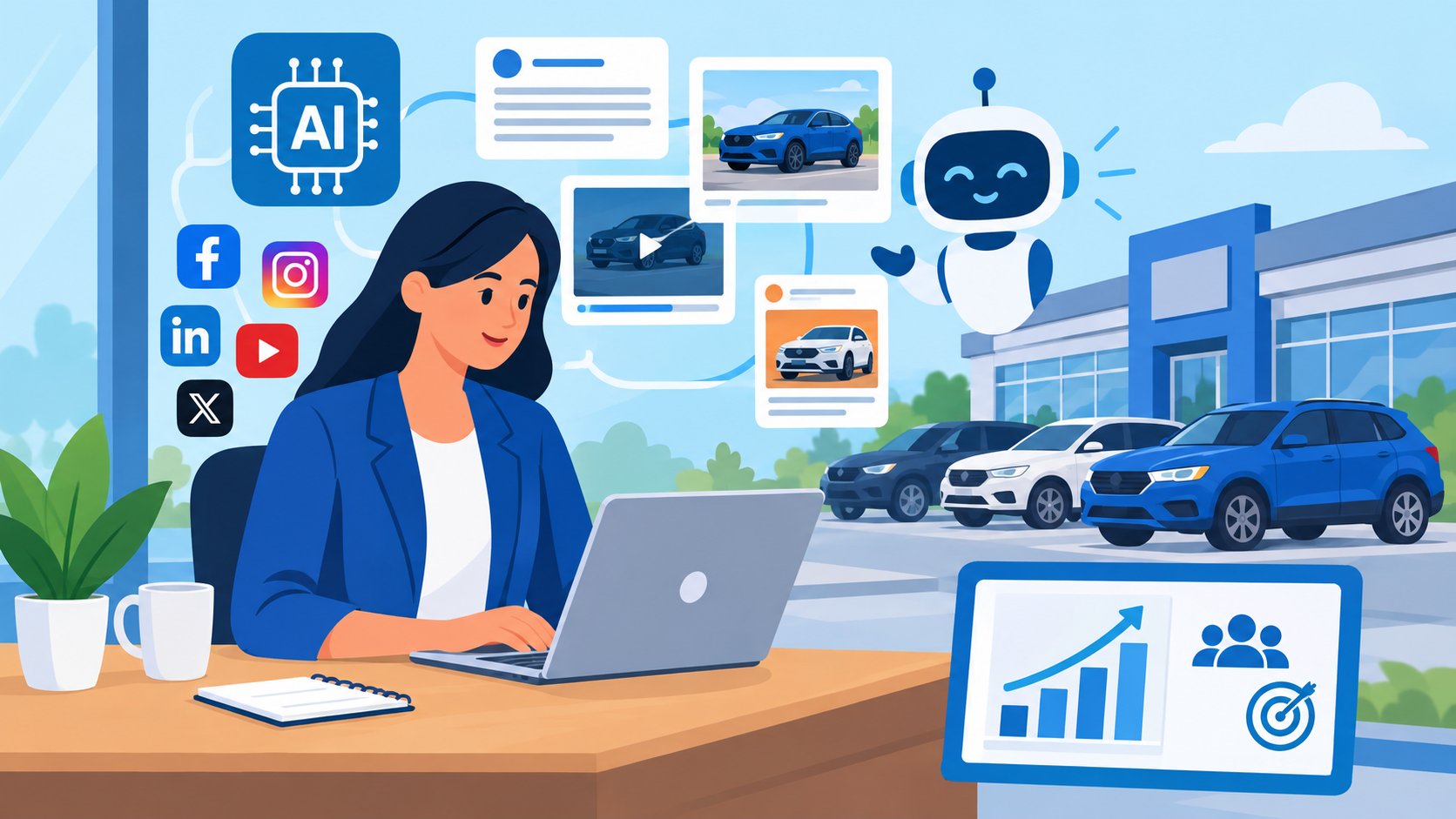
Generative AI is changing how dealerships approach social media marketing. From creating social media captions and promotional ideas to developing visual concepts, responding to common customer questions, and repurposing existing content, AI can help dealership teams work faster without sacrificing creativity.
The key is not to let AI replace your marketing strategy or human interaction. Instead, dealerships can use generative AI as a practical tool that supports their marketing team, improves productivity, and creates more opportunities to engage potential customers.
For dealerships competing for attention in crowded local markets, combining a strong social media strategy with AI-powered content creation can make it easier to maintain visibility, communicate value, and turn online attention into real business opportunities.
Generative AI refers to artificial intelligence technology capable of creating new content based on instructions, examples, and available information. Depending on the tool, it can produce written copy, images, video concepts, marketing ideas, summaries, and other forms of digital content.
For dealerships, this technology can reduce the amount of time required to move from a marketing idea to a finished social media post.
Instead of starting every post from a blank page, a marketing team can use AI to generate initial ideas, create different versions of copy, develop content themes, or adapt a message for multiple social platforms.
However, effective AI marketing is not simply about generating as much content as possible. The goal is to create useful, relevant, and brand-consistent content that gives customers a reason to pay attention.
Customers increasingly research businesses online before deciding where to spend their money. Social media gives dealerships another opportunity to appear in front of potential customers during that research process.
A dealership’s social media presence can showcase products, explain services, highlight promotions, answer common questions, introduce team members, and demonstrate what makes the business different.
It also provides an opportunity to build familiarity.
Someone may not be ready to contact a dealership after seeing one post. But consistent, useful content can keep the dealership visible until that customer is ready to take the next step.
This is where generative AI can become particularly useful. By reducing the time needed to produce content, AI can help dealerships maintain a more consistent publishing schedule.
Generative AI can support nearly every stage of a dealership’s content workflow. The most effective applications are not necessarily the most complicated ones.
Creating quality content consistently can be difficult when a small marketing team is responsible for multiple channels.
Generative AI can help create initial drafts for:
Instead of spending hours developing every post from scratch, marketers can use AI to produce a starting point and then refine it.
This allows the team to spend more time on strategy, customer engagement, and creative direction.
One of the biggest challenges in social media marketing is simply knowing what to post.
A dealership can use generative AI to brainstorm content around customer questions, seasonal promotions, common objections, product categories, local events, and industry trends.
For example, instead of repeatedly posting promotional messages, a dealership could create content explaining how its products work, what customers should consider before buying, common mistakes to avoid, or questions customers should ask before making a purchase.
This creates a more balanced content strategy.
A message that works well on Facebook may not be ideal for Instagram or LinkedIn.
Generative AI can help adapt the same core idea for different platforms while maintaining the dealership’s overall brand message.
A product announcement, for example, could become a concise Instagram caption, a more detailed Facebook post, and a professional LinkedIn update.
The content remains consistent, but the presentation is adjusted to match the platform and its audience.
Visual content is an important part of modern social media marketing. Product photography, promotional graphics, diagrams, illustrations, and short videos can help businesses communicate information more effectively.
Generative AI can assist with visual concepts and creative production, particularly when a dealership needs supporting graphics for educational or promotional campaigns.
That does not mean every dealership should replace real photography with AI-generated images.
Actual products, locations, employees, customers, and experiences can provide authenticity that artificial visuals cannot always replicate. AI is most useful when it complements genuine brand assets rather than attempting to replace them entirely.
Different customers have different needs.
A new prospect may want basic information about products and pricing, while an existing customer may be more interested in service, upgrades, or additional offerings.
Generative AI can help marketers create variations of content for different customer segments.
For example, a dealership could develop separate messaging for new customers, repeat customers, commercial clients, local businesses, or customers interested in specific product categories.
Personalization makes social media content more relevant and can help businesses communicate with customers based on their specific interests.
The real value of generative AI comes from using it as part of a structured content strategy.
Without a plan, AI can produce a large amount of content without necessarily producing meaningful results.
A dealership should first determine what it wants social media to accomplish.
Possible objectives include increasing brand awareness, generating leads, driving website traffic, promoting products, supporting sales, educating customers, or increasing engagement with existing customers.
Once the objective is clear, AI can help support the execution.
One of the easiest ways to create useful social media content is to identify questions customers frequently ask.
These questions can become individual posts, videos, graphics, FAQs, or longer-form articles.
For example, if customers frequently ask about pricing, availability, product differences, contracts, installation, or service options, those questions can become recurring content themes.
This approach makes content more useful because it starts with actual customer needs rather than simply trying to fill a posting calendar.
Not every social media post needs to make a direct sales pitch.
Educational content can establish credibility and give customers a reason to follow the dealership.
A dealership might explain industry terminology, compare product options, answer common questions, or explain what customers should look for when evaluating a purchase.
Generative AI can help turn complex information into shorter, easier-to-understand social media content while allowing the marketing team to maintain control over the final message.
AI can also help dealerships get more value from content they have already created.
A blog article can become several social media posts. A long-form article can be turned into a short video script. A customer FAQ can become a carousel-style post. A product explanation can become several educational updates.
This content repurposing approach can dramatically extend the useful life of existing marketing assets.
For dealerships investing in broader business opportunities, educational content can also help explain different revenue streams. For example, information about building a solar panel dealership business can be adapted into social posts that explain the opportunity, customer demand, and potential business model.
Creating content is only one part of social media marketing.
Customers also expect businesses to respond to questions and messages in a reasonable amount of time.
AI-powered chatbots and automated systems can assist with common inquiries, helping customers find basic information without requiring a team member to answer every repetitive question manually.
Potential uses include:
Automation should have clear boundaries, however.
Questions involving pricing exceptions, complaints, complex technical issues, contracts, or sensitive customer situations may require a real person.
The best approach is to use AI to handle routine interactions while making it easy for customers to reach a human representative when necessary.
Generative AI can create content quickly, but speed should never come at the expense of accuracy.
Dealership teams should review AI-generated content before publishing it, particularly when posts contain pricing, product specifications, promotions, policies, or claims about services.
Human review also helps maintain a consistent brand voice.
AI-generated content can sometimes sound overly generic or repetitive. Adding real dealership experiences, local references, customer questions, employee perspectives, and specific product knowledge can make the final content feel much more authentic.
Think of AI as a marketing assistant rather than the entire marketing department.
Using generative AI effectively requires more than generating a prompt and publishing the result.
AI-generated information can contain errors or outdated details. Every important claim should be checked before publication.
Customers can quickly lose interest when every post sounds like a generic advertisement.
Give AI specific information about your audience, products, location, brand personality, and marketing objective to produce more useful drafts.
Automation is valuable for routine questions, but customers should not feel trapped in a conversation with a bot.
Provide a clear path to human assistance.
A social media feed filled entirely with sales messages can become repetitive.
Mix promotional content with educational information, customer questions, behind-the-scenes content, industry insights, and useful tips.
AI can help create content, but analytics should determine whether that content is actually working.
Track engagement, clicks, inquiries, leads, and conversions to identify which types of posts are generating meaningful results.
Social media becomes more valuable when it supports the dealership’s broader business objectives.
For example, a dealership offering telecom products can use educational content to explain different products and services before directing interested prospects toward the next step.
Content focused on selling telecom products for additional dealership revenue can help demonstrate how social media education can connect directly with a broader sales strategy.
The important distinction is between attention and action.
Likes and comments can indicate engagement, but businesses ultimately need measurable outcomes. Depending on the dealership, those outcomes may include website visits, phone calls, form submissions, consultations, applications, appointments, or completed sales.
A simple workflow can make generative AI much more practical for dealership marketing teams.
Determine who the content is intended to reach.
Consider their needs, questions, buying stage, location, and reasons they might choose one dealership over another.
Decide whether the post is designed to educate, engage, generate leads, promote a product, drive traffic, or support an existing campaign.
Use AI to create several concepts rather than relying on the first response.
Multiple variations make it easier to choose a message that fits the brand.
Insert accurate product details, dealership information, customer insights, local references, and other details that make the content specific.
Check facts, tone, formatting, claims, links, and calls to action.
Monitor how the content performs and identify which topics and formats generate the strongest response.
Use performance data to refine future prompts, topics, messaging, and publishing decisions.
This creates a continuous cycle of planning, creating, publishing, measuring, and improving.
Generative AI is becoming another tool in the broader digital marketing toolbox. Dealerships that learn how to use it effectively can potentially produce content more efficiently while giving their marketing teams more time for higher-value activities.
But technology alone does not create a successful marketing strategy.
The strongest results come from combining AI with clear positioning, accurate information, authentic customer communication, strong creative direction, and consistent execution.
Dealership owners should also think beyond individual social media posts. A broader digital strategy can include content marketing, search optimization, lead generation, email marketing, paid advertising, and customer relationship management.
If you’re evaluating different dealership business models, understanding what to look for when choosing a franchise opportunity can also help you think about marketing resources, support, operational requirements, and long-term growth potential.
The role of AI in digital marketing will continue to evolve.
For dealerships, that means the ability to create and personalize content will likely become faster and more accessible. Businesses that develop practical AI workflows now can build experience before these tools become even more deeply integrated into everyday marketing operations.
However, the competitive advantage will not necessarily belong to the dealership that publishes the most AI-generated content.
It will belong to the dealership that uses technology intelligently.
Authentic customer stories, knowledgeable employees, accurate product information, strong service, and a recognizable brand still matter. AI can help amplify those strengths, but it cannot replace the underlying value of a good business.
For dealerships expanding their product offerings, even specialized opportunities such as becoming a Cox dealer and expanding telecom product offerings can benefit from a thoughtful digital marketing strategy that clearly communicates the value of the opportunity.
Generative AI gives dealerships a powerful way to rethink social media marketing.
It can reduce content production time, generate new ideas, support personalization, help repurpose existing content, and assist with routine customer interactions. More importantly, it can give small marketing teams the ability to operate with greater efficiency.
The technology works best when it supports a clear strategy rather than replacing one.
Use AI to accelerate research, brainstorming, drafting, and content production. Then add the human expertise that makes the content accurate, credible, and relevant to your customers.
For dealerships looking to strengthen their digital presence, that combination can create a more consistent social media strategy while freeing up valuable time for sales, customer relationships, and business growth.
Generative AI can help dealerships brainstorm content ideas, write social media captions, create campaign concepts, develop video scripts, repurpose existing content, and assist with routine customer interactions.
Yes. AI can create initial drafts for different types of dealership social media posts. However, the dealership should review and personalize the content before publishing it to ensure accuracy and maintain an authentic brand voice.
Generative AI can help create visual concepts and marketing graphics. However, real photos of products, employees, locations, and customer experiences can provide valuable authenticity and should remain an important part of the overall content strategy.
No. Automation can improve efficiency, but completely automated marketing can make a brand feel impersonal. A combination of AI assistance, scheduled content, analytics, and human interaction generally provides a more balanced approach.
There is no single posting frequency that works for every dealership. Consistency and content quality are more important than publishing simply for the sake of volume. Businesses should test different frequencies and use performance data to determine what works for their audience.
Provide AI with specific information about the dealership, target audience, products, customers, location, and brand voice. After generating a draft, add real examples, customer insights, local details, and natural language before publishing.
AI is better viewed as a productivity tool than a replacement for a marketing team. Human marketers remain important for strategy, brand positioning, fact-checking, creative decisions, customer relationships, and interpreting performance data.
Track metrics that connect social activity to business objectives. Depending on the campaign, these may include engagement, website traffic, clicks, inquiries, lead submissions, calls, appointments, and sales.

Telecom Lead Management: Follow Up Without Losing Sales
Oct 19, 2026

Franchise Law Basics: What Every Owner Should Know
Oct 16, 2026

How Cox Business Products Help Dealers Drive Growth
Oct 15, 2026

7 Reasons to Become a Vivint Authorized Reseller
Oct 14, 2026

Why Become an Internet Provider Dealer? 7 Key Benefits
Oct 13, 2026

19
Oct, 2026
DEALER
Telecom lead management is the process of organizing, qualifying, contacting, and following up with potential...
15
Oct, 2026
COX DEALER
Businesses depend on reliable internet, voice, and security solutions to operate efficiently and serve customers....
13
Oct, 2026
DEALER
Becoming an internet provider dealer can be an opportunity to build a business around services...