BUSINESS IDEAS
How to Boost Consumer Conversion, Acquisition, and Retention
Turning potential customers into loyal buyers takes more than a great product or an effective...
Learn More

 August 18, 2026
Rural broadband opportunities are among the most underpenetrated in telecommunications, with millions of households and small businesses still relying on slow, unreliable connections. Dealers who serve these markets can build real recurring revenue. Competition is low. Customer demand is high. Satellite and fixed wireless solutions make it possible.
Rural broadband refers to high-speed internet services delivered to geographic areas that traditional cable and fiber infrastructure has not reached. These areas represent a disproportionately large share of unserved and underserved households in the United States.
According to the FCC’s Broadband Data Collection, millions of Americans in rural areas lack access to fixed broadband at speeds meeting federal benchmarks — though the exact figure varies depending on methodology and the reporting period cited. (Note: the FCC voted in 2024 to update its fixed broadband speed benchmark from 25/3 Mbps to 100/20 Mbps, meaning the share of rural Americans considered underserved may be substantially larger under the updated standard.) Tens of millions more have only one viable provider, meaning effectively no competitive market.
For dealers, this creates two distinct advantages. First, there is genuine unmet demand: customers in these areas are not choosing between five providers, they are choosing between one slow option and nothing. Second, government funding is actively building out the infrastructure that makes new satellite and fixed wireless deployments commercially viable.
The result is a convergence of customer need, improved technology, and federal investment that is opening rural markets faster than at any point in the last decade.
The Broadband Equity, Access, and Deployment (BEAD) Program, authorized under the Infrastructure Investment and Jobs Act, allocates approximately $42.45 billion specifically to expand broadband in unserved and underserved locations. States are actively distributing these funds to ISPs and service providers.
For dealers, this creates a practical opportunity: as funded providers expand into newly served areas, those providers need distribution channels to reach customers. Authorized dealers become that channel. Dealers who establish themselves in rural markets before buildout completes will have a first-mover advantage when residents begin actively shopping for service.
Understanding the technical differences between satellite and fixed wireless internet is not optional for dealers working rural markets. Customers will ask, and the wrong recommendation leads to returns, cancellations, and lost trust.
Satellite internet delivers connectivity by transmitting data between a dish at the customer’s location and an orbiting satellite. Two distinct architectures are active in the market as of 2026.
Geostationary (GEO) satellite — Providers like HughesNet and Viasat use satellites positioned approximately 22,000 miles above Earth. The distance creates measurable latency, typically in the range of 500–600 milliseconds or more round-trip, though actual figures vary by provider and conditions. This is noticeable during video calls and real-time applications but largely invisible during streaming, email, and general browsing. HughesNet offers broad national coverage across the continental United States and many additional areas, making it one of the most geographically flexible options a dealer can offer — though dealers should verify current coverage maps for specific locations, including Alaska and Hawaii.
Low-Earth Orbit (LEO) satellite — Starlink, operated by SpaceX, uses a constellation of satellites positioned at varying low-earth orbital altitudes — commonly reported in the range of approximately 340 to 570 miles for its primary constellation shells, with some additional satellites operating higher. This dramatically reduces latency to roughly 20–60 milliseconds in most conditions, making it functionally comparable to cable internet for most use cases. LEO satellite is the fastest-growing technology in rural broadband as of 2025–2026.
In practice, customers who need video conferencing for remote work or have school-age children doing online coursework will notice the difference between GEO and LEO. Customers who primarily stream video or use basic internet applications will find GEO satellite service entirely adequate, especially at a lower price point.
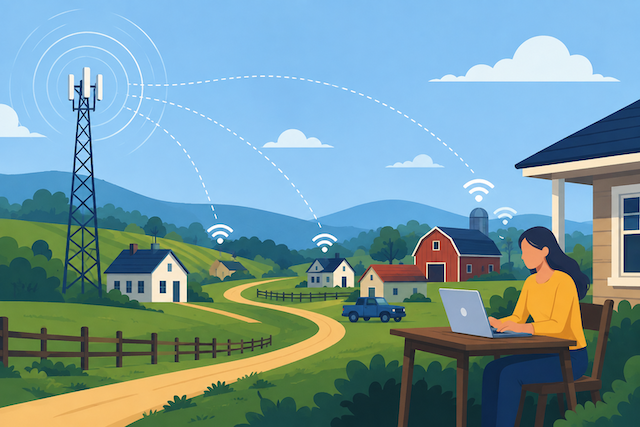
Fixed wireless access (FWA) delivers internet service via radio signals transmitted from a tower to an antenna mounted on the customer’s structure. Unlike satellite, FWA does not require a line-of-sight connection to space — but it does require the customer to be within range of a tower and without significant terrain obstruction.
FWA speeds typically range from 25 Mbps to well over 100 Mbps depending on the provider, the frequency band used, and local network conditions — with some providers using mid-band or millimeter-wave 5G advertising significantly higher peak speeds. Providers using licensed mid-band spectrum — the 3.5 GHz CBRS band, for example — tend to deliver more consistent speeds than those relying on unlicensed spectrum in many deployments, though actual performance depends on a range of variables including tower density, interference, and network management practices.
The key selling point of FWA is lower latency than GEO satellite combined with competitive pricing. The key limitation is coverage: FWA is only viable where a provider has deployed tower infrastructure. For dealers, this means matching the technology to the customer’s specific location before committing to a sale.
| Technology | Typical Latency | Speed Range | Coverage Area | Best For |
|---|---|---|---|---|
| GEO Satellite (HughesNet, Viasat) | 600+ ms | 25–150 Mbps | Nationwide | Basic use, remote areas |
| LEO Satellite (Starlink) | 20–40 ms | 50–250 Mbps | Near-nationwide | Remote work, gaming |
| Fixed Wireless Access | 20–50 ms | 25–100+ Mbps | Tower-dependent | Rural with coverage |
| DSL (rural) | 15–30 ms | 1–25 Mbps | Limited | Legacy fallback only |
Identifying high-opportunity rural markets is a matter of combining publicly available data with ground-level local knowledge.
The FCC’s National Broadband Map allows anyone to search broadband availability at the address level. Dealers can use this tool to identify specific ZIP codes and census blocks where residents have only one or zero broadband options. These are your highest-priority target areas.
Search for areas where the only available technology listed is DSL at speeds below 25 Mbps or where “no service” is indicated. These households are your warmest prospects — they have the problem you can solve, and they know it.
Rural communities have natural aggregation points: farm supply stores, feed and grain cooperatives, local diners, and community centers. Dealers who establish relationships with these local anchors can generate referral traffic efficiently. A single conversation with a well-connected local business owner can produce more qualified leads than weeks of digital advertising in a rural market.
According to Pew Research Center, rural Americans are significantly more likely to say they rely on community word-of-mouth recommendations when making purchasing decisions compared to urban residents. That changes the marketing calculus meaningfully: in rural markets, relationships often outperform digital ads.
Rural small businesses — farms, contractors, healthcare clinics, schools, and professional offices — often have even greater connectivity frustration than residential customers. A farm operation managing IoT sensors, weather monitoring, and equipment telemetry cannot function on a 5 Mbps DSL line. A rural healthcare clinic trying to conduct telemedicine appointments over a geostationary satellite with 600 ms latency is at a practical disadvantage.
Small business prospects in rural markets represent higher average revenue per customer, longer contract terms, and stickier relationships than residential accounts. Learning to sell internet provider products to business customers requires a slightly different approach, but the commission upside justifies the investment in that skill.
Not every provider is suited for every rural market. Dealers working rural territory should focus on building a portfolio that covers multiple technologies and price points.
HughesNet is available virtually anywhere in the continental United States with a clear view of the southern sky. For deeply rural customers where no other option exists, HughesNet is often the only viable solution. The JNA Dealer Program includes access to HughesNet, and the benefits of HughesNet for dealers include national coverage and competitive commission structures.
Viasat offers higher speed tiers than HughesNet in many markets and targets customers who need more bandwidth. Understanding the differences between Viasat and satellite alternatives helps dealers position each provider correctly without creating buyer confusion.
Fixed wireless providers vary by region and include regional ISPs, rural electric cooperatives building out their own networks, and T-Mobile Home Internet, which uses the T-Mobile 5G network to deliver FWA nationally. Dealers should assess tower coverage in their specific territory before adding a FWA provider to their portfolio.
Xfinity and Cox are primarily urban and suburban providers, but in some markets, their service areas extend into semi-rural corridors. Dealers who serve mixed urban-rural territories can become an authorized Xfinity dealer to capture the suburban and exurban segments while using satellite for the more remote customers.
One of the structural advantages of rural broadband sales is the recurring revenue model. Internet service subscriptions renew monthly, and customer churn in rural areas is significantly lower than in urban markets, where competitive switching is common.
A dealer who acquires 50 rural broadband customers in the first six months of operation has built a commission stream that compounds over time. As the telecom dealer commission structure rewards both new activations and retention, rural markets are particularly favorable for dealers who think about long-term revenue rather than one-time sales.
The practical approach to building recurring revenue in rural markets involves three steps:
Overselling speed expectations. Satellite internet, particularly GEO satellite, has real limitations. Dealers who promise performance comparable to cable fiber create customers who cancel within 90 days. Be accurate about latency and peak-hour slowdowns during the sales conversation, not after the installation.
Ignoring data caps. Both HughesNet and Viasat use data threshold systems that reduce speeds after a set monthly usage. Customers who stream 4K video for multiple hours daily will exceed these thresholds. Match the customer’s usage habits to the correct plan tier before completing the sale.
Skipping the coverage check. For fixed wireless, coverage verification is non-negotiable. Selling FWA service to a customer who is outside the tower’s reach, or who has a ridge blocking the signal path, results in an installation failure that costs everyone time and money.
Underestimating installation complexity. Satellite dishes require proper mounting with a clear line of sight. In rural areas with significant tree cover, finding the right installation point requires patience. Build realistic expectations with customers about the installation process before they sign up.
Satellite internet uses orbiting satellites to deliver connectivity to virtually any location, making it the best option for customers in areas with no tower infrastructure. Fixed wireless access uses ground-based towers to transmit radio signals to antennas on the customer’s property, delivering lower latency than geostationary satellite but requiring the customer to be within range of a deployed tower. The right choice depends entirely on the customer’s location and the provider’s coverage in that specific area.
The FCC’s National Broadband Map at broadbandmap.fcc.gov allows dealers to search availability by address, ZIP code, and census block. Areas showing only one provider, or no provider offering speeds above 25 Mbps, represent the highest-priority unserved markets. State broadband offices also publish lists of unserved and underserved locations tied to BEAD Program funding allocations.
Rural broadband sales are profitable, and in many cases more so than urban markets on a per-customer basis. Competition is lower, customer churn is lower, and commission structures for satellite providers are competitive with cable and fiber programs. The main challenge is reaching customers who are geographically dispersed, which requires a different lead-generation strategy than door-to-door canvassing in a dense neighborhood.
Yes. Multi-product dealerships that offer both satellite and fixed wireless options are better positioned to serve the full range of rural customers than dealers locked into a single provider. The JNA Dealer Program’s multi-provider structure allows dealers to match each customer to the most appropriate technology rather than fitting every customer into the same product. This approach improves customer satisfaction and reduces post-sale cancellations.
As of 2026, the primary federal program is the BEAD Program, which allocates $42.45 billion to states for broadband infrastructure deployment in unserved and underserved areas. The FCC’s Emergency Connectivity Fund and the USDA’s ReConnect Program also provide funding for specific rural broadband projects. These programs do not directly fund dealer commissions, but they accelerate infrastructure deployment that creates more customers for dealers to serve.
Rural broadband via satellite and fixed wireless is viable for small business use, with some caveats. GEO satellite’s latency makes it less suitable for real-time applications like VoIP phone systems and video conferencing. LEO satellite and fixed wireless both deliver latency comparable to cable internet, making them practical for most business applications including telemedicine, cloud software, and remote team communication. For business customers, verifying the specific use case before recommending a technology is critical.
Rural broadband is not a niche opportunity — it is one of the largest underserved markets in American telecommunications, backed by billions in federal investment and populated by customers who are actively looking for solutions. Dealers who build expertise in satellite and fixed wireless technology, establish community relationships in target territories, and join a program like the JNA Dealer Program with multi-provider access are positioned to capture a share of a market that is growing every year. The next step is identifying your target territory on the FCC Broadband Map and requesting your authorized dealer application through JNA Dealer Program.

Telecom Lead Management: Follow Up Without Losing Sales
Oct 19, 2026

Franchise Law Basics: What Every Owner Should Know
Oct 16, 2026
How Cox Business Products Help Dealers Drive Growth
Oct 15, 2026

7 Reasons to Become a Vivint Authorized Reseller
Oct 14, 2026

Why Become an Internet Provider Dealer? 7 Key Benefits
Oct 13, 2026


9
Oct, 2026
BUSINESS IDEAS
Turning potential customers into loyal buyers takes more than a great product or an effective...
7
Sep, 2026
HOME SECURITY
Choosing the right home security system is about more than installing a few cameras or...

19
Aug, 2026
HOME SECURITY
Customer lifetime value telecom dealer performance depends on one core metric — CLV — the...