DEALER
Why Become an Internet Provider Dealer? 7 Key Benefits
Becoming an internet provider dealer can be an opportunity to build a business around services...
Learn More

 August 10, 2026
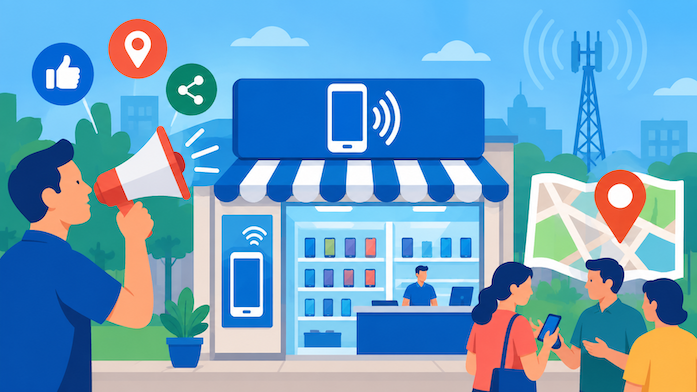
A local marketing strategy for telecom dealers focuses your advertising budget and outreach efforts on the specific geographic territory where you can actually close sales — rather than competing for national attention you cannot convert. Done correctly, local marketing drives foot traffic, generates qualified leads, and builds the kind of community trust that sustains long-term recurring revenue.
A local marketing strategy is a coordinated set of tactics designed to attract customers within a specific geographic area — typically the service territory assigned to an authorized dealer by a carrier or provider. For telecom and home security dealers, this means marketing Xfinity, Spectrum, AT&T, Vivint, or similar products to households and small businesses in a defined region rather than competing in a national marketplace.
The distinction matters because your inventory of potential customers is finite and geographic. Every dollar you spend reaching someone outside your service area is a dollar that cannot convert.
National brand campaigns run by carriers already build broad awareness of the products you sell. Your job as a dealer is to capture local demand that those campaigns generate — and to create additional demand within your community before a competitor does.
Generic digital advertising — running untargeted Facebook ads or boosting posts without geographic restrictions — spreads your budget across users who may live hundreds of miles from your territory. The cost-per-lead climbs while the close rate drops.
Local marketing inverts that ratio. You spend less to reach people who are genuinely serviceable, and you convert at a higher rate because you can speak directly to their neighborhood, their specific service options, and their local concerns.
If you are building recurring revenue as a telecom dealer, local marketing is the engine that keeps new customers entering your pipeline to replace natural churn.
Google Business Profile is widely considered one of the highest-impact local marketing assets a dealer can control. When someone searches “Xfinity dealer near me” or “home security installer in [city],” Google’s local pack — the map results that typically appear below paid ads but above organic listings — is often among the first results users interact with.
To optimize your profile:
Google has indicated that businesses with complete profiles are more likely to be considered reputable by customers — and that perception directly affects whether a prospect calls you or the next listing.
A local citation is any mention of your business name, address, and phone number (NAP) on an external website. Search engines use citation consistency to verify that your business is legitimate and located where you claim.
The directories that matter most for telecom dealers include:
Your NAP must be identical across every listing — including abbreviations like “St.” versus “Street.” Inconsistencies confuse search engines and suppress your local rankings.
Your website needs to rank for the searches your prospects actually type. For a telecom dealer, those include:
Create a dedicated page for each city or region you serve. Each page should include the service area name in the H1, a unique description of the services available there, and an embedded Google Map. These location pages are one of the fastest ways to capture organic search traffic from high-intent local searches.
For dealers selling multiple products, this pairs naturally with broader content — for example, a page explaining fiber vs. satellite internet options gives your local pages contextual authority while answering pre-purchase questions your prospects are already asking.
Meta (Facebook and Instagram) and Google Ads both allow you to restrict ad delivery by radius from a specific address or by ZIP code. For dealers, a 10–15 mile radius targeting is typically the right starting point, adjusted based on your actual service territory boundaries.
The highest-converting local ad formats for telecom and security dealers include:
Keep your geographic targeting tight. Spending $500 per month on a 5-mile radius delivers a higher concentration of impressions to serviceable prospects than the same budget spread across a 50-mile radius.
Nextdoor is a neighborhood-focused social network used by approximately 1 in 3 U.S. households. For telecom and home security dealers, it provides direct access to residential customers organized by neighborhood — which is exactly your target audience.
Nextdoor Business pages are free to create. You can also run paid “Neighborhood Sponsorships” that display your business to users in selected ZIP codes at a lower cost-per-impression than Facebook in most local markets.
Beyond paid placements, engaging genuinely in local conversations — answering questions about internet providers, recommending security solutions, or responding to complaints about poor service from a competitor — builds organic visibility and positions you as a local expert.
Referral marketing performs exceptionally well in telecom because the product (internet, phone, or home security service) is something every household needs and people regularly discuss with neighbors and family. A structured referral program — where existing customers receive a bill credit, gift card, or cash incentive for each qualified referral — amplifies your local reach without paid media costs.
The key is making the referral process frictionless. A dedicated referral link, a simple text message template, or a QR code on a card left at the time of installation all reduce the barrier to action. For a deeper breakdown of how referral marketing drives dealer sales, the referral marketing guide for telecom dealers covers the full mechanics.
Local events — farmers markets, home improvement expos, neighborhood association meetings, school fundraisers — put you in direct contact with homeowners who are your ideal customers. The cost to participate is typically low, and the trust you build by showing up in person is difficult to replicate online.
Specific tactics that work well for dealers:
Spending money without measuring results is the fastest way to waste a local marketing budget. The metrics that matter most for telecom dealer marketing are:
| Metric | What It Measures | Target Benchmark |
|---|---|---|
| Cost per lead (CPL) | Marketing spend divided by leads generated | Varies by product; track weekly trends |
| Lead-to-install conversion rate | Percentage of leads that result in a completed sale | Aim for 20–40% depending on channel |
| Google Business Profile views | How often your profile appears in local search | Should grow month-over-month |
| Review volume and rating | Trust signals that affect local ranking | Minimum 4.2-star average; request reviews at every install |
| Referral rate | Percentage of new customers from referrals | 15–25% is achievable with a structured program |
| Customer acquisition cost (CAC) | Total marketing spend divided by new customers | Compare against lifetime value of each customer |
Review these metrics monthly at a minimum. Shift budget toward channels where CPL is falling and away from channels where it is rising — do not maintain spend on a channel out of habit.
For context on CAC benchmarks and how to reduce it, the customer acquisition cost guide provides calculation frameworks applicable directly to dealer businesses.
Ignoring reviews until there is a problem. Your Google rating affects your local pack ranking directly. Dealers who proactively request reviews at every install maintain higher ratings than those who only respond after receiving a negative one.
Running ads with no geographic restriction. This is one of the most common and expensive mistakes new dealers make. Always set a radius or ZIP code restriction on every paid campaign, and audit your settings monthly — platforms sometimes expand targeting automatically.
Treating all neighborhoods the same. In practice, certain ZIP codes in your territory will have higher incomes, higher homeownership rates, or higher concentrations of households currently on inferior service plans. Segment your territory and allocate more marketing budget to the neighborhoods with the highest conversion probability.
Neglecting seasonal timing. Internet and home security purchases spike during specific periods — new movers in spring and summer, back-to-school in late summer, and holiday promotions in Q4. A dealer with a seasonal marketing calendar aligned to these peaks will consistently outperform competitors who market at a flat rate year-round.
Building no local online presence beyond a Facebook page. A Facebook page alone does not rank in Google search. You need a website with local landing pages, a verified Google Business Profile, and consistent directory listings working together.
There is no universal figure, but a practical starting point is 5–10% of your monthly revenue from active accounts, reinvested into marketing. Dealers in competitive markets or in growth phases should lean toward the higher end. The more important discipline is tracking cost per lead and cost per acquisition so you can increase spend on channels that are working and cut those that are not.
Google Business Profile optimization and a targeted referral program are the two highest-return starting points for a new dealer with a limited budget. Neither requires significant upfront spend, and both can generate leads within days of setup. Paid geo-targeted social ads on Facebook are a close third, particularly lead generation campaigns targeting homeowners aged 30–65 in your service ZIP codes.
Direct mail remains effective for telecom dealers in residential markets, particularly for targeting specific ZIP codes or apartment complexes. Response rates for direct mail average 4.4% for prospect lists, according to the Data & Marketing Association. That is significantly higher than most digital display ads. The constraint is cost — printing and postage make direct mail a higher-budget tactic best suited to dealers with an established revenue base.
Your competitive advantage is local expertise, personalized service, and the ability to handle installation, troubleshooting, and follow-up that a big-box retailer cannot. Lean into this in all your local marketing. Customer testimonials from neighbors, Google reviews mentioning your name specifically, and your ability to show up in person all create differentiation that a national retailer cannot replicate.
You do not need a separate domain — but you do need dedicated location pages on your existing website for each city or service area you actively target. Each page should have unique content, local keywords, and a local phone number or trackable call routing if possible. A single generic homepage does not rank well for “[city]-specific” searches.
Reviews are critical — both for ranking in Google’s local pack and for converting prospects who find you there. According to BrightLocal, 76% of consumers regularly read online reviews when searching for local businesses. A dealer with 50 reviews averaging 4.5 stars will consistently outrank and out-convert a competitor with 10 reviews averaging 3.8 stars, all else being equal.
Local marketing for telecom dealers is not a campaign — it is an infrastructure. Google Business Profile authority, review volume, citation consistency, and community relationships all compound in value over months and years. A dealer who builds this infrastructure in year one operates with significantly lower customer acquisition costs by year two.
Start with the foundation: claim your Google Business Profile today, audit your directory listings for NAP consistency, and implement a post-installation review request process this week. Then layer in geo-targeted ads, community partnerships, and a structured referral program as your revenue grows.
Every authorized dealer in your territory is competing for the same finite pool of local customers. The dealer with the strongest local presence — online and in the community — wins the majority of that pool.

Franchise Law Basics: What Every Owner Should Know
Oct 16, 2026
How Cox Business Products Help Dealers Drive Growth
Oct 15, 2026
7 Reasons to Become a Vivint Authorized Reseller
Oct 14, 2026

Why Become an Internet Provider Dealer? 7 Key Benefits
Oct 13, 2026

Veterans Guide to Small Business Loans and Funding
Oct 12, 2026

13
Oct, 2026
DEALER
Becoming an internet provider dealer can be an opportunity to build a business around services...

2
Oct, 2026
DEALER
Dealer programs give businesses a practical way to sell products or services while benefiting from...

25
Sep, 2026
DEALER
The holiday season creates a valuable sales window for telecom dealers because customers are already...