BUSINESS
How to Get an EIN for Your Dealer Business
Starting a dealer business means paperwork before profit. Before you sell your first phone plan,...
Learn More

 July 27, 2026
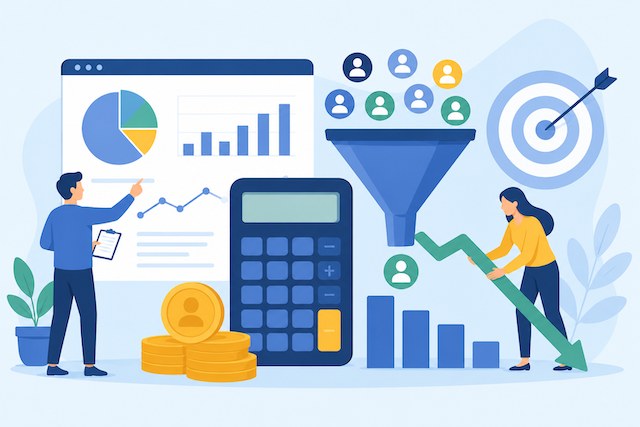
Every business owner wants more customers. But before you pour another dollar into ads, promotions, or sales efforts, there is one number you need to understand: your customer acquisition cost, or CAC.
Knowing your CAC tells you exactly how much you spend to earn each new customer. Without it, you are essentially guessing with your marketing budget. And for small business owners, dealers, and telecom retailers, that kind of guesswork can drain cash flow fast.
The good news? Calculating and lowering your CAC is straightforward once you know the steps. This guide breaks it down in plain language and gives you practical ways to bring that number down without sacrificing growth.
Customer acquisition cost is the total amount of money a business spends to attract and convert a new customer. It includes everything that goes into getting someone through the door, whether that door is physical or digital.
The formula is simple:
CAC = Total Sales and Marketing Spend / Number of New Customers Acquired
If you spent $5,000 on marketing last month and gained 50 new customers, your CAC is $100 per customer. That number becomes your benchmark. Every decision you make about advertising, staffing, and promotions should filter through that lens.
Many business owners focus on revenue and profit margins, which are important. But CAC sits at the intersection of those two metrics. If your profit per customer is $80 and your CAC is $100, you are losing money on every new sale. That is a recipe for trouble.
Here is why tracking CAC deserves your attention:
For telecom dealers and authorized retailers, where commission structures and product margins vary widely, keeping a close eye on CAC is especially important.
Let us walk through the calculation step by step.
Start by gathering every expense tied to acquiring customers over a specific period, usually a month or a quarter. This includes:
Do not include costs for retaining existing customers, such as loyalty programs or support staff. CAC is strictly about bringing in new business.
Next, count how many new customers you acquired during that same time period. For a telecom dealer, this might be the number of new service installations or phone activations. For a retailer, it might be the number of first-time buyers.
Make sure you are only counting new customers, not repeat purchases from existing ones.
Take your total marketing spend and divide it by the number of new customers. The result is your CAC.
Example:
That $125 tells you what each new customer costs you. Now the question becomes whether that number is sustainable.
There is no universal “right” number for CAC. It depends on your industry, your average customer value, and your profit margins.
For telecom dealers, a reasonable CAC might fall between $50 and $200 per customer, depending on the services being sold and the commission structure. For home security dealers, installation-heavy models may push CAC higher because of upfront labor and equipment costs.
The key metric to compare against is customer lifetime value, or CLV. If a customer stays with your service for three years and generates $600 in total revenue, spending $120 to acquire that customer is a strong investment. Spending $300 to acquire the same customer? That is where problems start.
A general rule: your CAC should be significantly lower than your CLV. If CAC is more than one-third of your total customer lifetime value, you need to find ways to bring it down.
Before you can fix the problem, you need to identify what is driving the cost up. Here are the most common culprits.
If your ads are reaching people who are not interested in what you sell, you are paying for impressions that never convert. Narrow your targeting. For a telecom dealer, that might mean focusing on households in specific zip codes rather than running broad regional campaigns.
Paid advertising is fast, but it is expensive. If every new customer comes through a $3-per-click ad, your costs add up quickly. Diversifying into organic channels, referral programs, and local partnerships can bring your blended CAC down considerably.
Getting traffic is one thing. Turning that traffic into paying customers is another. If your website loads slowly, your sales pitch is unclear, or your follow-up process is inconsistent, you are leaking potential customers at every stage.
Acquiring a customer is expensive. Letting that customer walk away without ever referring someone else is wasteful. Businesses without referral or loyalty programs tend to have higher CACs because every sale has to come from scratch.
Now for the practical part. Here are proven methods to reduce your CAC without sacrificing the quality of your customer base.
For dealers and retailers with physical locations, local search is one of the highest-ROI channels available. When someone nearby searches for “phone dealer near me” or “home security installation,” you want to appear at the top of those results.
Optimizing your Google Business Profile with accurate hours, photos, services, and customer reviews costs nothing and drives qualified leads directly to your door. Pair that with basic local SEO on your website, and you will start attracting customers who are already looking for what you sell.
Word of mouth is the oldest marketing channel in existence, and it remains one of the cheapest. A structured referral program gives your existing customers an incentive to bring in new ones.
Consider offering account credits, discounts on their next bill, or a small cash reward for every successful referral. The cost of a referral bonus is almost always lower than the cost of acquiring a customer through advertising.
Not every lead is ready to buy immediately. Email marketing lets you stay in front of potential customers without paying for ad clicks every time. Build an email list through your website, in-store sign-ups, or social media, and send regular updates with useful content, promotions, and service highlights.
A well-segmented email list can convert at rates of 3-5% or higher, making it one of the most cost-effective acquisition tools in your arsenal.
Content marketing takes time to build momentum, but the payoff is significant. Writing blog posts, shooting quick videos, or creating social media content that answers the questions your customers are already asking positions you as a trusted authority. Using the right marketing tools to expand your reach makes the process more efficient and consistent.
For example, a telecom dealer might create content comparing internet plans, explaining how to switch providers, or reviewing the latest smartphones. Each piece of content attracts organic traffic and moves potential customers closer to a purchase decision, all without paying for ads.
Sometimes the problem is not how you attract customers but how you close them. Review your sales process for friction points. Are your quotes easy to understand? Do you follow up promptly? Is your team trained to handle objections confidently?
Small improvements in your close rate can dramatically reduce CAC because you are converting a higher percentage of the leads you already have. Investing in sales training tools for your team is one of the most direct ways to improve close rates and bring CAC down.
Partnering with complementary businesses gives you access to their customer base at a fraction of the cost of traditional advertising. A phone dealer might partner with a local insurance agency. A home security installer might team up with a real estate agent or a home builder.
These partnerships create mutual value and often cost nothing more than a reciprocal arrangement or a small commission. If you are still in the early stages of setting up your business, having a solid business plan that accounts for partnership opportunities from the start will save you time and money down the road.
Calculating CAC once is useful. Tracking it consistently is powerful.
Set up a monthly review of your acquisition costs. Use a simple spreadsheet or a dashboard in your CRM to record:
Over time, patterns will emerge. You will see which campaigns produce the best results, which seasons drive the highest acquisition costs, and where you should reallocate budget for maximum impact. Pairing your CAC tracking with a broader review of small business metrics gives you a complete picture of where your business stands and where it needs to go.
For businesses using a dialer system or lead generation tools, tracking the cost per lead and the cost per acquisition from outbound campaigns is especially valuable. These numbers help you decide whether to scale up dialing efforts or shift resources toward inbound channels.
Here is a point that many business owners overlook: your pricing and financing options directly affect your CAC.
When customers have access to flexible payment plans or financing options, the barrier to purchase drops significantly. A customer who cannot afford a $500 upfront cost may happily sign up for a plan with a manageable monthly payment. That means you close more deals from the same number of leads, which lowers your effective CAC.
If you are exploring business financing options to invest in marketing, inventory, or equipment, make sure you factor the expected return into your decision. A loan that helps you hire an additional sales rep or open a new location can pay for itself many times over if it brings down your CAC and increases your customer base.
Customer acquisition cost is not just a number on a spreadsheet. It is a window into the health and efficiency of your entire business development strategy.
When your CAC is low and your customer lifetime value is high, every part of your operation benefits. You have more budget to reinvest in growth, more margin to absorb unexpected costs, and more freedom to experiment with new products and services.
Start by calculating your current CAC. Benchmark it against your customer lifetime value. Then systematically work through the strategies outlined above to bring it down.
The businesses that master this metric do not just survive. They grow on purpose, with every marketing dollar working as hard as it possibly can.
Telecom Lead Management: Follow Up Without Losing Sales
Oct 19, 2026
Franchise Law Basics: What Every Owner Should Know
Oct 16, 2026
How Cox Business Products Help Dealers Drive Growth
Oct 15, 2026
7 Reasons to Become a Vivint Authorized Reseller
Oct 14, 2026

Why Become an Internet Provider Dealer? 7 Key Benefits
Oct 13, 2026

4
Aug, 2026
BUSINESS
Starting a dealer business means paperwork before profit. Before you sell your first phone plan,...