DEALER
Why Become an Internet Provider Dealer? 7 Key Benefits
Becoming an internet provider dealer can be an opportunity to build a business around services...
Learn More

 August 6, 2026
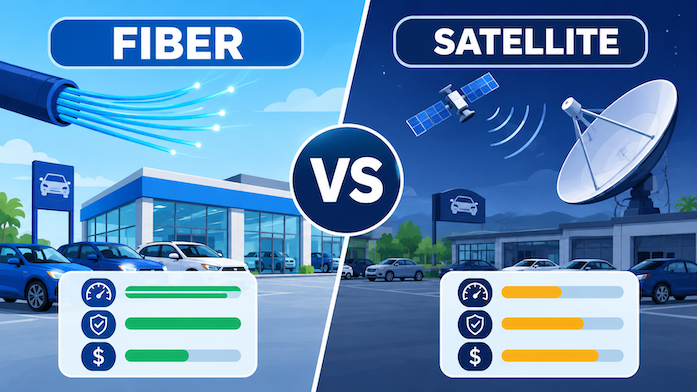
For dealers comparing fiber internet vs satellite internet for dealers and customers alike, this is one of the most common — and consequential — conversations in ISP sales. Fiber internet and satellite internet serve very different customer needs. As a dealer, knowing how to position each technology is what separates a closed sale from a customer who walks away. Fiber delivers fast, symmetrical speeds and low latency over physical cables. Satellite internet — led by Starlink and HughesNet — serves customers where laying cable is not practical. That typically means rural and remote areas where fiber infrastructure does not exist.
Fiber internet transmits data as pulses of light through glass or plastic strands, delivering speeds that are symmetrical — meaning upload speeds match download speeds — with latency that can reach as low as 1ms to 10ms at the access layer under ideal conditions, though end-to-end consumer latency may be somewhat higher depending on distance to exchange and network routing. That physical infrastructure is fixed, stable, and unaffected by weather or network congestion at the access layer.
Satellite internet transmits data between a ground dish and an orbiting satellite. Traditional geostationary (GEO) satellites orbit at approximately 35,700 kilometres above Earth, producing round-trip latency typically in the range of 500ms to 600ms, and potentially higher under congested or adverse conditions. Low-Earth orbit (LEO) services like Starlink operate at significantly lower altitudes than GEO satellites, reducing latency to roughly 25ms to 60ms in reported real-world use — a dramatic improvement, but still meaningfully higher than fiber. Specific orbital altitudes and latency figures have evolved as Starlink’s constellation has expanded, so dealers should verify current published specifications at starlink.com.
Customers fixate on download speed because it is the number ISPs advertise most prominently. In practice, for the majority of residential use cases in 2026, latency determines the quality of experience, not raw throughput.
Video calls on Zoom or Microsoft Teams, online gaming, live commerce, and real-time financial applications all degrade at high latency regardless of download speed.
A household on a 1Gbps satellite connection with 60ms latency will have a noticeably worse video call experience than the same household on a 500Mbps fiber connection with 5ms latency.
This is the single most powerful talking point a fiber dealer can deploy in a customer comparison conversation.
Customer qualification is not a pre-sales formality — it is the foundation of a sustainable dealer business. Recommending the wrong technology leads to cancellations, complaints, and in commission-structured programs, clawbacks.
Ask these questions before recommending either technology:
The goal is to match technology to need, not to steer every customer toward the higher-margin product.
Fiber is the easier sell in urban and suburban markets where availability is confirmed. Use these points to close with confidence:
Symmetrical speeds are a genuine differentiator. Most cable internet plans deliver asymmetric speeds — typically offering substantially lower upload than download at comparable price points, though exact figures vary by provider and are shifting as DOCSIS 4.0 deployments expand.
Providers offering genuine fiber-to-the-home (FTTH) connections, such as Comcast Business on its fiber tiers, can offer symmetrical speeds. Dealers should confirm whether a specific address is served by full fiber or a hybrid fiber-coaxial (HFC) network, as symmetrical speeds may not be available across all footprints. For any customer uploading large files, video conferencing, or backing up to cloud storage, this difference is immediately noticeable.
No congestion at the local level. Unlike cable and satellite networks, fiber infrastructure does not share bandwidth at the last-mile level in the same way. During peak hours — typically 7pm to 11pm — cable and satellite users often see significant speed degradation. Fiber customers generally do not.
Future-proofed infrastructure. The physical glass strand that delivers fiber today is capable of carrying far more data than current equipment utilises. Upgrading a fiber network is largely a matter of updating the electronics at each end, not replacing the cable. Customers who care about long-term value respond well to this point.
Reliability in adverse weather. Unlike satellite connections — which can be disrupted by heavy rain, snow, or even dense cloud cover — fiber is unaffected by weather at the access layer. This matters to customers in states with significant seasonal weather patterns.
For dealers working within the JNA Dealer Program’s portfolio of internet provider products, fiber-capable provider partnerships such as Xfinity and Comcast Business represent some of the strongest commission opportunities in the current market.
Dealers who dismiss satellite as an inferior product lose sales in markets where it is the only viable technology. According to the Broadband Deployment Advisory Committee, rural broadband access remains one of the most persistent infrastructure challenges in the United States as of 2026.
For customers outside fiber and cable coverage areas, satellite is not a compromise — it is the solution. Here is how to position it:
LEO satellite has fundamentally changed the value proposition. Starlink’s performance in 2025 and 2026 regularly achieves download speeds of 100Mbps to 250Mbps with latency between 25ms and 60ms in clear conditions. For most non-gaming, non-VoIP-heavy households, that is entirely adequate. Do not oversell the limitations if the customer’s use case does not trigger them.
No infrastructure dependency means instant availability. A fiber connection requires physical infrastructure in the customer’s area. Satellite equipment ships to the customer’s address and self-installs within hours. For customers in new rural developments, remote properties, or areas recovering from infrastructure damage, this speed of deployment is a genuine advantage.
HughesNet and Viasat serve specific budget-conscious rural segments. While Starlink dominates the LEO conversation, GEO satellite providers still hold value for customers with lower data needs and tighter budgets. Dealers with access to HughesNet reseller programs or Viasat authorized reseller arrangements have a complete rural coverage toolkit.
Portability is a differentiating factor. Starlink’s portable and roaming options appeal to RV owners, seasonal property owners, and businesses operating across multiple sites. No fiber product can match this use case.
Acknowledge it honestly. Satellite hardware costs are real — Starlink’s standard kit runs approximately $349 upfront as of early 2025, with monthly service on top. The counter-argument: if the customer lives outside fiber or cable coverage, the comparison is not between satellite and fiber. It is between satellite and no reliable high-speed internet at all. Frame the cost against the value of having a consistent 200Mbps connection versus intermittent cellular data or slow DSL.
LEO satellite is meaningfully more resilient than GEO predecessors, but acknowledge that heavy precipitation and obstructions can affect performance. Then ask: does their current service handle bad weather perfectly? Often the honest answer is no. Satellite’s weather sensitivity is real but overstated in popular perception relative to its actual impact on day-to-day use.
Many fiber providers now offer month-to-month options at a slight premium, or introductory promotions that transition to standard pricing. Know your provider’s current contract terms cold. Customers who object to contracts are often responding to a bad past experience — acknowledging that and presenting the actual terms disarms the objection more effectively than simply defending the provider.
Ask which service. GEO satellite (HughesNet, Viasat) and LEO satellite (Starlink) have profoundly different performance profiles. A neighbour’s experience with HughesNet’s 25Mbps throttled plan from 2021 is not representative of what Starlink delivers in 2026. Use specific, current data to correct the comparison.
| Factor | Fiber Internet | LEO Satellite (Starlink) | GEO Satellite (HughesNet/Viasat) |
|---|---|---|---|
| Typical Download Speed | 300Mbps – 5Gbps | 100Mbps – 250Mbps | 25Mbps – 100Mbps |
| Typical Upload Speed | 300Mbps – 5Gbps | 10Mbps – 20Mbps | 3Mbps – 10Mbps |
| Latency | 1ms – 10ms | 25ms – 60ms | 500ms – 700ms |
| Weather Sensitivity | None (access layer) | Low to moderate | Moderate to high |
| Availability | Urban/suburban | Near-universal (US) | Near-universal (US) |
| Equipment Cost | Usually $0–$100 | ~$349 hardware | ~$100–$200 hardware |
| Monthly Cost Range | $40 – $100+ | $120 – $250+ | $50 – $100+ |
| Contract Requirements | Varies by provider | Month-to-month | Often 12–24 months |
| Best Use Case | High-demand households, business | Rural residential, remote | Budget-conscious rural |
The most effective dealers in the JNA Dealer Program treat technology recommendations as a trust-building exercise, not a transaction. Customers who feel they received honest guidance — even when the honest answer is “satellite is actually right for you” — come back, refer neighbours, and do not generate cancellations that hurt dealer metrics.
In practice, this means:
According to J.D. Power, customer satisfaction with internet service providers in 2024 was most strongly correlated with whether the customer felt they received the right product recommendation at the point of sale — not with the technology itself. That finding directly validates the qualification-first approach described in this post.
For dealers looking to develop a broader sales framework, the dealer success guide at JNA covers qualification, objection handling, and commission optimisation across all product categories.
The structure that converts most reliably in ISP dealer conversations follows this sequence:
For dealers expanding into internet provider sales, the JNA Dealer Program’s ISP dealer opportunities provide the provider partnerships and training resources to execute this script across multiple carriers.
Fiber is the stronger recommendation for remote workers where it is available. The symmetrical upload speeds and sub-10ms latency produce noticeably better video call quality and cloud application performance than even the best LEO satellite connections. Satellite remains a viable option for remote workers in rural areas without fiber access, particularly for roles that do not require real-time video conferencing at scale.
Ask them whether anyone in the household video calls, backs up photos to the cloud, or works from home. Every one of those activities is limited by upload speed, not download speed. Frame upload speed as “how fast your home can talk back to the internet” — the analogy resonates with customers who are accustomed to thinking about internet speed as a one-way measure.
Yes. The JNA Dealer Program operates as a one-stop provider with partnerships across multiple telecommunications carriers, including both fiber-capable ISPs and satellite service providers. This allows dealers to make technology-agnostic recommendations based on customer need and geography, which is both more ethical and more effective for long-term dealer reputation.
Recommending based on margin rather than fit. Customers who receive a product that does not match their needs cancel, complain, and do not refer others. Commission clawbacks in many dealer programs also mean that a mismatched sale often costs the dealer money rather than making it. Qualification-first selling is both the ethical and financially optimal approach.
Not in the near term. LEO satellite networks face capacity constraints as subscriber numbers grow — performance can degrade in densely populated areas where many users share the same satellite overhead. Fiber’s physical infrastructure does not have this constraint at the access layer. The two technologies are likely to serve distinct market segments for the foreseeable future rather than converge into direct competition for the same customers.
Quarterly at minimum. ISP pricing, hardware costs, and promotional structures change frequently. Starlink has adjusted its pricing and plan tiers multiple times since its commercial launch, and fiber providers regularly run competitive promotions. Dealers who rely on outdated pricing in customer conversations lose credibility and sales. Subscribe to provider partner newsletters and set a calendar reminder to verify current rates.
The fiber vs. satellite conversation is not a debate that dealers should approach as if there is a single right answer. The right answer depends entirely on where the customer lives, how they use the internet, and what they can afford.
Dealers who master customer qualification, know their coverage maps, and can articulate the genuine strengths of each technology — in plain language, without jargon — will consistently outperform dealers who push a single preferred product. The JNA Dealer Program’s multi-carrier portfolio exists precisely to make that technology-agnostic approach possible. Use it as the competitive advantage it is.
To explore the full range of ISP and telecommunications dealer opportunities available through the JNA Dealer Program, visit jnadealerprogram.com.

Franchise Law Basics: What Every Owner Should Know
Oct 16, 2026
How Cox Business Products Help Dealers Drive Growth
Oct 15, 2026

7 Reasons to Become a Vivint Authorized Reseller
Oct 14, 2026

Why Become an Internet Provider Dealer? 7 Key Benefits
Oct 13, 2026

Veterans Guide to Small Business Loans and Funding
Oct 12, 2026

13
Oct, 2026
DEALER
Becoming an internet provider dealer can be an opportunity to build a business around services...

2
Oct, 2026
DEALER
Dealer programs give businesses a practical way to sell products or services while benefiting from...

25
Sep, 2026
DEALER
The holiday season creates a valuable sales window for telecom dealers because customers are already...