
 October 27, 2026

Looking for the best smartphones to buy in 2026? Today’s smartphones offer powerful processors, advanced camera systems, brighter displays, longer software support, and AI-powered features that make everyday tasks easier. Whether you need a phone for business, photography, gaming, or everyday communication, there are more options to consider across different budgets.
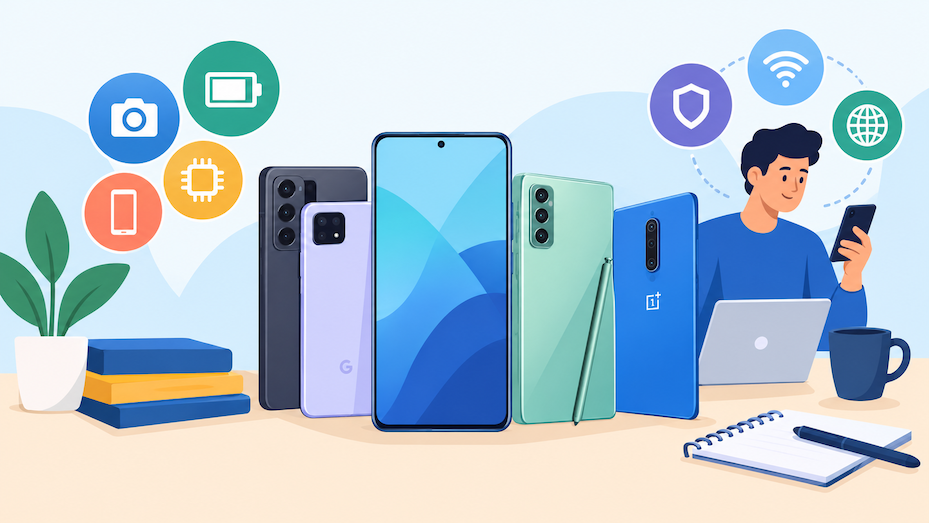
Leading manufacturers such as Samsung, Apple, Google, and OnePlus continue to compete by improving performance, battery life, camera quality, and productivity features. Some phones focus on premium photography and multitasking, while others offer a practical balance of features and price.
The best smartphone for you depends on how you plan to use it, how much you want to spend, and how long you expect to keep it. In this article, we’ll explore notable smartphones for 2026, compare their strengths, and explain what to look for before making a purchase.
Key Takeaways
-
Best premium Android option: The Samsung Galaxy S26 Ultra offers high-end performance, advanced cameras, and productivity features.
-
Best everyday Android option: The Google Pixel 10 combines a premium Android experience with versatile cameras and AI features.
-
Best budget-oriented option: The Google Pixel 10a offers a more affordable route to Google’s software and camera features.
-
Best iPhone option to consider: The Apple iPhone 17 provides a balance of performance, camera quality, and everyday usability.
-
Best performance-focused Android option: The OnePlus 15 emphasizes speed, battery life, and a smooth display.
-
Before buying: Compare local prices, warranty coverage, network compatibility, software support, and battery performance.
Best Smartphones to Buy in 2026
The following models represent different approaches to smartphone design and performance. The right choice depends on your budget, preferred operating system, and priorities.
1. Samsung Galaxy S26 Ultra: Premium Performance and Productivity
The Samsung Galaxy S26 Ultra is a premium Android smartphone designed for users who want advanced hardware, versatile photography, and productivity features in one device.
Samsung’s latest S-series lineup emphasizes performance, AI-assisted features, and improvements to the overall mobile experience. The S26 Ultra is particularly relevant to professionals and users who regularly work with documents, photographs, videos, and demanding applications.
Its large display makes reading, multitasking, and reviewing content comfortable. The camera system is designed for different shooting situations, including detailed photographs and zoom photography. Samsung’s S Pen support also makes the Ultra series attractive to people who prefer handwriting notes or annotating documents.
Who should consider it?
-
Professionals who use their phones for work and communication.
-
Photography enthusiasts who want a versatile camera system.
-
Users who frequently multitask or use productivity applications.
-
People who prefer a large display and premium Android features.
The main consideration is cost. Premium models can be expensive, so compare the Ultra with the standard Galaxy S26 and Galaxy S26+ before paying for features you may not use.
For buyers in the Philippines, check local pricing, warranty terms, storage configurations, and the exact model’s network compatibility before purchasing.
2. Google Pixel 10: A Versatile Android Phone for Everyday Use
The Google Pixel 10 is worth considering if you want a refined Android experience, capable cameras, and useful AI-powered software features.
Google’s Pixel phones emphasize computational photography, which uses software processing to improve the appearance of photographs. This can help with exposure, detail, portraits, and other everyday shooting situations.
The Pixel 10 also offers a smooth display and a capable processor for everyday applications, communication, browsing, and entertainment. Its camera system provides more flexibility than older Pixel models that relied primarily on a single rear camera.
Google’s software approach is another advantage for people who prefer a straightforward Android interface with integrated Google services.
Who should consider it?
-
Users who regularly take photographs.
-
People who prefer Google’s Android interface.
-
Professionals who use Google Workspace and related applications.
-
Buyers who want premium features without necessarily choosing the largest flagship phone.
Before buying, compare the Pixel 10 with the Pixel 10 Pro and Pixel 10a. Consider storage capacity, camera requirements, local availability, and the remaining software support period.
3. Google Pixel 10a: An Affordable Smartphone Option
The Google Pixel 10a is a practical option for buyers who want a more affordable smartphone without automatically sacrificing camera quality or software features.
The Pixel A-series has traditionally focused on delivering useful everyday performance at a lower price than Google’s flagship models. The 10a continues that approach with a combination of photography features, AI tools, and a straightforward Android experience.
For everyday tasks such as messaging, browsing, video calls, online shopping, and social media, a phone in this category may provide everything many users need.
It can also be an option for students, employees, and small-business owners who want a capable device without paying for premium hardware they rarely use.
Who should consider it?
-
Budget-conscious buyers.
-
Students and everyday smartphone users.
-
People who prioritize photography and software features over premium materials.
-
Small-business owners looking for practical communication devices.
Compare its camera capabilities, charging speed, processor performance, storage, and display with similarly priced Samsung Galaxy A-series phones. Also verify whether the Pixel 10a is officially available in your market or is being sold through an importer.
4. Apple iPhone 17: A Balanced Choice for iOS Users
The Apple iPhone 17 is an option for people who prefer Apple’s iOS ecosystem and want a phone suitable for everyday use, photography, communication, and productivity.
Its appeal includes strong processing performance, a high-quality display, and a dual-camera system designed for everyday photography and video recording.
The iPhone can also work particularly well for users who already own other Apple devices. Features across the Apple ecosystem can make it easier to share files, manage notifications, and move between supported devices.
For business users, the iPhone’s application ecosystem and integration with common productivity tools can be useful for email, scheduling, video conferencing, and document management.
Who should consider it?
-
Existing iPhone users who want to upgrade.
-
People who prefer iOS over Android.
-
Users who take photographs and record videos regularly.
-
Professionals who rely on compatible Apple devices and applications.
The iPhone 17 may not be the right choice for everyone. Buyers should compare it with newer iPhone models, consider storage requirements, and check whether the additional features of a Pro model justify its higher price.
If you’re moving from Android, also consider how you will transfer your contacts, photographs, messages, and other files.
5. OnePlus 15: Performance and Battery Life
The OnePlus 15 is designed for users who prioritize speed, battery endurance, display responsiveness, and a premium Android experience.
Its flagship-oriented hardware makes it relevant to people who frequently switch between applications, play demanding games, stream videos, or use their phones for extended periods.
OnePlus has also placed considerable emphasis on fast charging and display performance in its recent flagship devices. These features can be useful for users who need to recharge quickly or want a smooth experience when navigating applications.
The phone’s camera system provides additional flexibility for everyday photography, portraits, and wide-angle shots.
Who should consider it?
-
Users who want strong performance for demanding applications.
-
Mobile gamers who value a responsive display.
-
People who prioritize battery life and charging speed.
-
Android users looking for an alternative to Samsung and Google.
Availability and after-sales support are important considerations. Check whether the specific OnePlus model is officially supported in your country, whether the warranty is local or international, and how easily replacement parts can be obtained.
How to Choose the Best Smartphone for Your Needs
A popular model is not necessarily the right phone for your situation. Before purchasing, identify the features you use most often and compare devices according to those priorities.
Set a Realistic Smartphone Budget
Smartphones are available at many price points, from entry-level devices to premium flagships.
Start with a budget that includes more than the initial purchase. Accessories, charging equipment, repairs, and mobile data expenses can add to the total cost.
If you primarily use your phone for calls, messaging, and browsing, an affordable model may be sufficient. If you create videos, play demanding games, or use professional applications, investing in stronger hardware may be worthwhile.
Compare the cost of owning the device over several years rather than focusing only on its launch price.
Compare Camera Quality and Video Features
Camera quality depends on more than megapixels. Image sensors, lens quality, stabilization, image processing, and low-light performance all affect the results.
If you regularly photograph products, record marketing videos, or publish social media content, look for real-world sample images and video tests.
Consider whether you need optical zoom, an ultrawide camera, reliable autofocus, or strong video stabilization. For everyday photography, a dependable main camera may matter more than having several secondary lenses.
Check Battery Life and Charging Speed
Battery life can influence how practical a smartphone is throughout the day.
Look for independent battery tests and consider your usual activities. Navigation, video calls, gaming, mobile data, and high screen brightness can increase power consumption.
Fast charging can reduce the time spent connected to a charger, while wireless charging adds convenience on compatible devices. However, charging speeds and included accessories vary by model and market.
Choose Enough Storage and Memory
Storage determines how many applications, photographs, videos, and documents you can keep on your phone.
If you frequently record videos or download large files, choose a model with sufficient internal storage. Cloud storage can help, but it may not replace local storage when you need files offline.
RAM also influences multitasking, although the amount required depends on the operating system and applications. Compare real-world performance instead of relying solely on specification numbers.
Consider Software Support and Security
Software updates are essential for security, compatibility, and long-term usability.
Before purchasing, check the manufacturer’s official update policy for the exact model. A phone with longer remaining support may be a better investment than an older flagship with impressive hardware but limited updates.
This is particularly important for people who use mobile banking, business email, customer information, and other sensitive applications.
Verify 4G, 5G, and Carrier Compatibility
5G can provide faster data speeds where supported networks are available, but performance depends on coverage, carrier support, and the device’s supported frequency bands.
If you’re buying a phone in the Philippines, confirm that it works with your chosen provider and supports the network bands used in the places where you regularly travel.
Imported models deserve extra attention because their network compatibility, warranty, and service arrangements may differ from locally sold versions.
Choosing a Smartphone for Business
A smartphone can function as a mobile office for sales professionals, entrepreneurs, and employees who need to communicate with customers throughout the day.
Look for reliable calling, good battery life, sufficient storage, strong security features, and compatibility with your organization’s applications.
For teams that need multiple devices, standardizing on a small selection of approved models can simplify training, technical support, and accessory purchases.
Businesses should also consider warranty coverage, repair costs, software support, and device management requirements. The cheapest phone is not necessarily the most cost-effective choice if it needs frequent repairs or becomes unsuitable for work after a short period.
If your business depends on mobile communication, compare smartphone features that support business productivity and daily operations before deciding which devices to purchase.
Frequently Asked Questions
What is the best smartphone to buy in 2026?
The best choice depends on your needs and budget. The Samsung Galaxy S26 Ultra suits users seeking premium Android features, while the Google Pixel 10 offers a balanced Android experience. The Pixel 10a is worth considering for a lower-cost option, and the iPhone 17 suits people who prefer iOS.
Which smartphone is best for business use?
A good business smartphone should offer dependable battery life, reliable connectivity, sufficient storage, strong security, and compatibility with work applications. Consider the Samsung Galaxy S26 series, Google Pixel 10 series, or Apple iPhone lineup based on your company’s requirements.
Is an expensive flagship smartphone worth buying?
A flagship may be worthwhile if you regularly use advanced cameras, demanding applications, premium displays, or productivity features. If you mainly make calls, send messages, and browse the internet, a midrange phone may provide better value.
Should I buy an Android phone or an iPhone?
Android offers a broad range of brands, designs, and prices. iPhones provide Apple’s iOS experience and integration with other Apple devices. Compare your preferred applications, budget, ecosystem, and expected software support before deciding.
Is 5G necessary in 2026?
Not for everyone. 5G is useful where coverage is available and your plan supports it, but 4G can still meet many users’ needs. Check your carrier’s coverage and the phone’s network compatibility before purchasing.
How long should a smartphone last?
A smartphone can remain useful for several years, but its practical lifespan depends on battery condition, physical durability, software support, and your performance requirements. Choose a model with a suitable update policy and repair options if you intend to keep it for a long time.
What should I check before buying a phone online?
Check the seller’s reputation, exact model number, storage configuration, network compatibility, warranty, return policy, and whether the device is new or refurbished. Compare the final price with reputable local sellers before placing an order.
Final Thoughts
The best smartphones to buy in 2026 offer different strengths depending on how you use your device. The Samsung Galaxy S26 Ultra focuses on premium Android features and productivity, the Google Pixel 10 offers a balanced camera and software experience, the Pixel 10a targets buyers looking for more affordable features, the iPhone 17 suits iOS users, and the OnePlus 15 emphasizes performance and battery life.
Before making your decision, compare local prices, software support, warranty coverage, battery performance, and network compatibility. A well-chosen smartphone should fit your budget, handle your daily tasks, and remain useful for years.